Advertisements
Advertisements
प्रश्न
<p> Define the unit of electric current (or Define ampere).
Advertisements
उत्तर
The SI unit of electric current is ampere.
When one coulomb of charge flows through any cross-section of a conductor in one second, the electric current flowing through it is said to be one ampere.
1 ampere= `(1coulomb)/(1second)`
संबंधित प्रश्न
The atoms of copper contain electrons and the atoms of rubber also contain electrons. Then why does copper conduct electricity but rubber does not conduct electricity?
Fill in the folloing blank with suitable words:
A current is a flow of ............... .For this to happen there must be a ............... circuit.
What is the conventional direction of the flow of electric current? How does it differ from the direction of flow electrons?
If the amount of electric charge passing through a conductor in 10 minutes is 300 C, the current flowing is:
(a) 30 A
(b) 0.3 A
(c) 0.5 A
(d) 5 A
Draw a circuit diagram showing two electric lamps connected in parallel together with a cell and a switch that works both lamps. Mark an â’¶ on your diagram to show where an ammeter should be placed to measure the current.
Name two devices which work on the heating effect of electric current.
The rating of a fuse connected in the lighting circuit is ______.
Two resistors P and Q of the same material and length but of different thickness are connected in parallel to a battery. The cross- sectional area of P is twice that of Q. What is the ratio of
(a) The resistance of P to the resistance of Q?
(b) The current in P to the current in Q?
Find the effective resistance in the following circuit diagrams (Fig.):
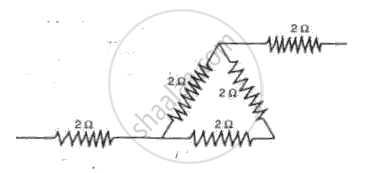
Complete the following table. The first answer has been given as an example.
| Quantity | Unit | |
| (a) | Electrical potential | volt |
| (b) | Resistance | ........ |
| (c) | Power | ........ |
| (d) | Energy | ........ |
| (e) | Resistivity | ........ |
If the potential differences between two parts of a thundercloud is 10s V,
what is the amount of energy given up during the passage of 20 coulombs?
(a)2x10⁻⁷J
(b)200J
(c)Sx106 j
(d)2x 10⁹J
(e)2x 10¹⁰ J
Three heaters each rated 250 W, 100 V are connected in parallel to a 100 V supply. Calculate :
The total current taken from the supply
Two electric bulbs rated 100 W; 220 V and 60 W; 220 V are connected in parallel to electric mains of 220 V. Find the current drawn by the bulbs from the mains.
How is direction of current related to the direction of flow of electrons?
Name any two devices, which are working on the heating effect of the electric current.
A charge of 400C flows through a conductor for 13 minutes and 20 seconds. Find the magnitude of the current flowing through the conductor.
The direction of Direct Current (DC) is characterized as:
