Advertisements
Advertisements
प्रश्न
<p> Define the unit of electric current (or Define ampere).
Advertisements
उत्तर
The SI unit of electric current is ampere.
When one coulomb of charge flows through any cross-section of a conductor in one second, the electric current flowing through it is said to be one ampere.
1 ampere= `(1coulomb)/(1second)`
संबंधित प्रश्न
Calculate the number of electrons constituting one coulomb of charge.
How many milliamperes as there in 1 ampere?
What is an electric current?
In 10 s, a charge of 25 C leaves a battery, and 200 J of energy are delivered to an outside circuit as a result.
- What is the p.d. across the battery?
- What current flows from the battery?
You can given one hundred 1 Ω resistors. What is the smallest and largest resistance you can make in a circuit using these?
An electrician has wired a house in such a way that if a lamp gets fused in one room of the house, all the lamps in other rooms of the house stop working. What is the defect in the wiring?
If the current passing through a conductor is doubled, what will be the change in heat produced
Which effect of current is utilised in the working of an electric fuse?
The work done in moving unit positive charge across two points in an electric circuit is a measure of
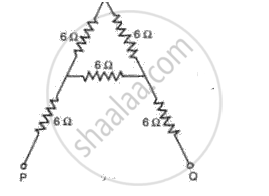
Find the effective resistance in the following circuit diagrams (Fig.):
What is the criteria for selecting a fuse wire?
In a house there are 6 bulbs of 100 W each used for 4 hours a day, 4 bulbs of 60 W each used for 8 hours a day, an immersion heater of 2.5 kW used for 1 hour per day, and an electric iron of 800 W used for 2 hours per day. Calculate the cost of monthly electric bill for the month of April at the rate of 80 p per unit.
An electric oven is rated as 1.5 kW, 250 V. If it is connected to a 250 V mains, calculate the
(a) Current drawn,
(b) Energy consumed in 20 hours,
(c) Cost of energy consumed in 20 hours at the rate of Re. 1 per unit.
Fill in the blank :
1 mA = ............................. A.
State whether the following statement is True or False:
The SI unit of charge is the coulomb.
Define an electric current.
