Advertisements
Advertisements
प्रश्न
In a house there are 6 bulbs of 100 W each used for 4 hours a day, 4 bulbs of 60 W each used for 8 hours a day, an immersion heater of 2.5 kW used for 1 hour per day, and an electric iron of 800 W used for 2 hours per day. Calculate the cost of monthly electric bill for the month of April at the rate of 80 p per unit.
Advertisements
उत्तर
Energy consumed by 6 bulbs per day = `6 xx 100/1000 xx 4 = 2.4 "kWh"`
Energy consumed by 4 bulbs per day = `4 xx 60/1000 xx 8 = 1.92 "kWh"`
Energy consumed by immersion heater per day = 2.5 x I= 2.5 kWh
Energy consumed by electric iron per day = `800/1000 xx 2 = 1.6 "kWh"`
Total energy consumed in I day= 2.4 + 1.92 + 2.5 + 1.6 = 8.42 kWh
Total energy consumed in the month of April (30 days) = 8.42 x 30 = 252.6 kWh
Electric bill for the month of April= 252.6 x 0.8 =Rs. 202.08
APPEARS IN
संबंधित प्रश्न
Why should the resistance of:
an ammeter be very small?
Which instrument is used to measure electric current? How should it be connected in a circuit?
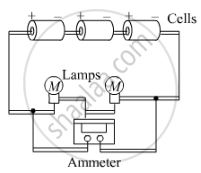
A student made an electric circuit shown here to measure the current through two lamps.
Are the lamps in series or parallel?
(a) Are the lamps in series or parallel?
(b) The student has made a mistake in this circuit. What is the mistake?
(c) Draw a circuit diagram to show the correct way to connect the circuit. Use the proper circuit symbols in your diagram.
What is the function of a step-up transformer?
An electric bulb is rated '100 W, 250 V'. How much current will the bulb draw if connected to a 250 V supply?
A current of 0.2 A flows through a wire whose ends are at a potential difference of 15 V. Calculate:
(i) The resistance of the wire, and
(ii) The heat energy produced in 1 minute.
My mother was operating washing machine on Sunday morning. Suddenly, she saw a spark coming out of the electric board and the electric current in the house failed. An electrician was called to look into the matter. What should he have noticed.
The power of an electric device is a product of ______ and ______.
The flow of electric charge per unit time is called potential difference.
