Advertisements
Advertisements
प्रश्न
Advertisements
उत्तर
संबंधित प्रश्न
Define the unit of current.
Write down the formula which relates electric charge, time and electric current
A car headlight bulb working on a 12 V car battery draws a current of 0.5 A. The resistance of the light bulb is:
Ten bulbs are connected in a series circuit to a power supply line. Ten identical bulbs are connected in a parallel circuit to an identical power supply line.
(d) Which circuit would have less current in it?
Consider the circuit given below:
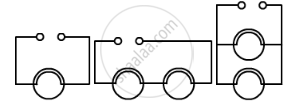
(a) In which circuit are the lamps dimmest?
(b) In which circuit or circuits are the lamps of equal brightness to the lamps in circuit (i)?
(c) Which circuit gives out the maximum light?
In which of the following cases more electrical energy is consumed per hour?
(i) A current of 1 ampere passed through a resistance of 300 ohms.
(ii) A current of 2 amperes passed through a resistance of 100 ohms.
State three factors on which the heat produced by an electric current depends. How does it depend on these factors?
Tick (✓) the correct choice among the following :
Which of the following changes would enable a millimeter to be used as a
direct current ammeter reading upto 1 A?
What are the effects of electric current?
