Advertisements
Advertisements
Question
What happens to the other bulbs in a parallel circuit if one bulb blows off?
Advertisements
Solution
When one of the bulbs in a parallel circuit blows off, it does not affect the other bulbs
APPEARS IN
RELATED QUESTIONS
Fill in the blank:
To increase the effective resistance in a circuit the resistors are connected in _____________.
In which direction does conventional current flow around a circuit?
Fill in the folloing blank with suitable words:
Current is measured in ............... using an ............... placed in ............... in a circuit.
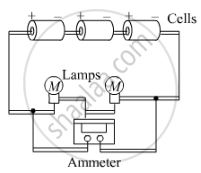
A student made an electric circuit shown here to measure the current through two lamps.
Are the lamps in series or parallel?
(a) Are the lamps in series or parallel?
(b) The student has made a mistake in this circuit. What is the mistake?
(c) Draw a circuit diagram to show the correct way to connect the circuit. Use the proper circuit symbols in your diagram.
A 5 V battery is connected to two 20 Ω resistors which are joined together in series.
(a) Draw a circuit diagram to represent this. Add an arrow to indicate the direction of conventional current flow in the circuit.
(b) What is the effective resistance of the two resistors?
(c) Calculate the current that flows from the battery?
(d) What is the p.d. across each resistor?
If you were going to connect two light bulbs to one battery, would you use a series or a parallel arrangement? Why? Which arrangement takes more current from the battery?
Which effect of current is utilised in the working of an electric fuse?
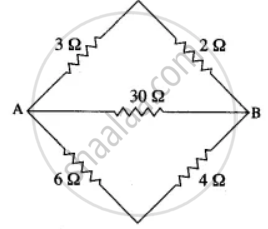
Calculate the equivalent resistance between A and B in the adjacent diagram.
If a fuse contains a 5 A fuse wire and the voltage is 240 V, what is the maximum power (wattage) which may be taken from the circuit?
A bulb marked 12 V, 24 W operates on a 12 V battery for 20 minutes. Calculate:
- The current flowing through it, and
- The energy consumed.
My mother was operating washing machine on Sunday morning. Suddenly, she saw a spark coming out of the electric board and the electric current in the house failed. An electrician was called to look into the matter. What should he have noticed.
______ is used to measure the electric current.
A current of 1 A is drawn by a filament of an electric bulb. Number of electrons passing through a cross section of the filament in 16 seconds would be roughly
In electrolytes such as salt solutions, the charge carriers are:
Electric current flows through a circuit only when:
