Advertisements
Advertisements
Question
Advertisements
Solution
Experiment 1
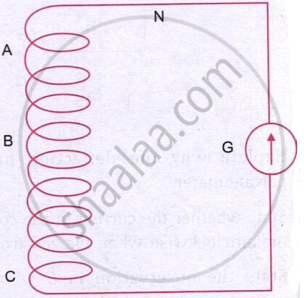
(i) Take a coil of wire AB having a large number of turns.
(ii ) Connect the ends of the coil to a galvanometer as shown in figure.
(iii ) Take a strong bar magnet and move i ts north pole towards the end B of the coil.
(iv) There is a momentary deflection in the needle of the galvanometer, say to the right. This indicates the presence of a current in the coil AB. The deflection becomes zero the moment the motion of the magnet stops.
(v) Now withdraw the north pole of the magnet away from the coil. Now the galvanometer is deflected toward the left, showing that th e current is now set up in the direction opposi te to the first.
(vi) Place the magnet stationary at a point near to the coil, keeping i ts north pole towards the end B of the coil. We see that the galvanometer needle deflects toward the right when the coil is moved towards the north pole of the magnet. Similarly the needle moves toward left when the coil is moved away.
(v) When the coil is kept stationary with respect to the magnet, the deflection of the galvanometer drops to zero.

Experiment 2
(i) Take two different coils of copper wire having large number of turns (say 50 and 100 turns respectively). Insert them over a non -conducting cylindrical roll, as shown in figure.
(ii ) Connect the coil -1, having larger number of turns, in series with a battery and a plug key. Also connect th e other coil -2 with a galvanometer as shown .
(iii ) Plug in the key. Observe the galvanometer. We will observe that the needle of the galvanometer instantly jumps to one side and just as quickly returns to zero, indicating a momentary current in coil -2.
(iv) Disconnect coil -1 from the battery. We will observe that the needle
momentarily moves, but to the opposi te side. It means that now the current flows in the opposi te direction in coil -2.

From these observations, we conclude that a potential difference is induced in the coil -2 whenever the electric current through the coil - 1 is changing (starting or stopping). This process, by which a changing magnetic field in a conductor induces a current in another conductor, is called electromagnetic induction.
To determine the direction of induced current, we use Fleming's left hand rule:
Stretch the thumb, forefinger and middle finger of right hand so that they are perpendicular to each other. If the forefinger indicates the direction of the magnetic field and the thumb shows the direction of motion of conductor, then the middle finger will show the direction of induced current.
Magnitude of induced current can be measured wi th the help of a galvanometer.
APPEARS IN
RELATED QUESTIONS
One coulomb charge is equivalent to the charge contained in:
(a) 2.6 × 10¹⁹ electrons
(b) 6.2 × 10¹⁹ electrons
(c) 2.65 × 10¹⁸ electrons
(d) 6.25 × 10¹⁸ electrons
Three 2 V cells are connected in series and used as a battery in a circuit.
- What is the p.d. at the terminals of the battery?
- How many joules of electrical energy does 1 C gain on passing through
- one cell
- all three cells?
The p.d. across a 3 Ω resistor is 6 V. The current flowing in the resistor will be:
(a) `1/2A`
(b) 1 A
(c) 2 A
(d) 6 A
What happens to the other bulbs in a parallel circuit if one bulb blows off?
Ten bulbs are connected in a series circuit to a power supply line. Ten identical bulbs are connected in a parallel circuit to an identical power supply line.
(c) In which circuit, if one bulb blows out, all other will stop glowing?
The work done in moving unit positive charge across two points in an electric circuit is a measure of
A strong short bar magnet is dropped into a solenoid connected to a
galvanometer as shown in fig. The galvanometer shows a deflection to the left when the current in the coil as seen from above is counter clockwise. Which one of the following shows the correct deflection of the galvanometer when the magnet is at posi tions A, Band C.
Problems for practice:
If 5A current flows through a circuit, then convert the current in terms of microampere?
Electric current passes through a metallic conductor due to the movement of ______.
Electric current is defined as:
