Advertisements
Advertisements
प्रश्न
Why should the resistance of:
a voltmeter be very large?
Advertisements
उत्तर
A voltmeter should have a high resistance so that it can take only a negligible amount of current from the circuit.
APPEARS IN
संबंधित प्रश्न
The atoms of copper contain electrons and the atoms of rubber also contain electrons. Then why does copper conduct electricity but rubber does not conduct electricity?
By what name is the physical quantity coulomb/second called?
An electric circuit consisting of a 0.5 m long nichrome wire XY, an ammeter, a voltmeter, four cells of 1.5 V each and a plug key was set up.
Following graph was plotted between V and I values:
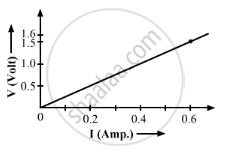
What would be the values of `V/I` rations when the potential difference is 0.8 V, 1.2 V and 1.6 V respectively?
What conclusion do you draw from these values?
What is the resistance of the wire?
A switch must be connected in ______.
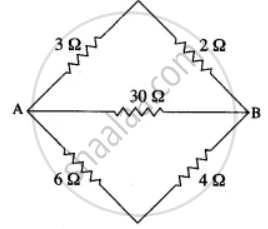
Calculate the equivalent resistance between A and B in the adjacent diagram.
Distinguish between an open and a closed circuit.
State the relation between work, charge and potential difference for an electric circuit.
A bulb marked 12 V, 24 W operates on a 12 volt car battery for 20 minutes. Calculate:
(i) The current flowing through it, and
(ii) The energy liberated.
Electrical power P is given by the expression P = (Q × V) ÷ time
(a) What do the symbols Q and V represent?
(b) Express the power P in terms of current and resistance explaining the meanings of symbols used there in.
Answer the following question.
What is the function of a galvanometer in a circuit?
Two electric bulbs rated 100 W; 220 V and 60 W; 220 V are connected in parallel to electric mains of 220 V. Find the current drawn by the bulbs from the mains.
Explain, why the potential difference across the terminals of a cell is more when the cell is not in use than it is when the cell is being used.
State expression for Cells connected in series.
What is the speed of electric current?
When an electric current is passed, electrons move from:
An ammeter is always placed in parallel with the circuit.
In metallic conductors, the charge carriers responsible for producing electric current are:
