Advertisements
Advertisements
प्रश्न
A current of 4 A flows around a circuit for 10 s. How much charge flows past a point in the circuit in this time?
Advertisements
उत्तर
Here:
Current, I = 4 A
Time, t = 10 s
We know that I = Q/t.
So:
4 = Q/10
or Q = 4 x 10 = 40 C
Thus, the amount of electric charge that flows through the circuit is 40 coulombs.
APPEARS IN
संबंधित प्रश्न
Compare how an ammeter and a voltmeter are connected in a circuit.
In the circuit diagram given below, three resistors R1, R2, and R3 of 5 Ω, 10 Ω and 30 Ω, respectively are connected as shown
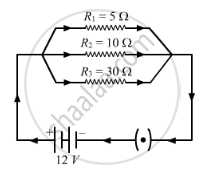
Calculate:
- current through each resistor.
- total current in the circuit.
- total resistance in the circuit.
A battery and three lamps are connected as shown:
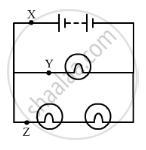
Which of the following statements about the currents at X, Y and Z is correct?
(a) The current at Z is greater than that at Y.
(b) The current at Y is greater than that at Z.
(c) The current at X equals the current at Y.
(d) The current at X equals the current at Z.
Give three reasons why different electrical appliances in a domestic circuit are connected in parallel.
An electric current flowing in a wire creates ______ around the wire.
Complete the following sentence:
A fuse is connected in ........... with the ......... wire.
What is international convention of colour coding in a cable?
Tick(✓) the correct choice in the following:
24 watt, 12 volt head lamp is fully lit by connecting it to a 12 volt
battery. The working resistance of the lamp is
Find the effective resistance in the following circuit diagrams (Fig.):
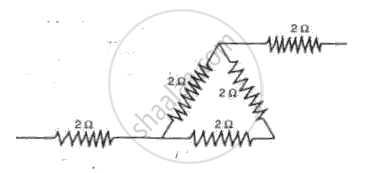
Fig. shows a 3 pin plug with the cover removed. The electric cable
connected to the plug contains 3 wires with colour coded insulation namely brown, blue and green.
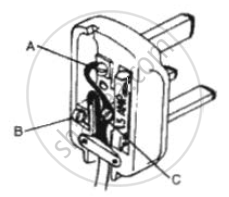
- Identify each of the colour coded wires by stating to which of the
terminals A, B or C in the diagram they should be connected. - Identify the terminal through which no current passes in normal
circumstances. - What is the purpose of the earthed wire connected to an electric
appliance like an electric heater? Describe how it works.
Calculate the current through a 60 W lamp rated 250 V. If the line voltage falls to 200 V, how is power consumed by the bulb affected?
An electric bulb is rated 250 W, 230 V.
- the energy consumed in one hour, and
- the time in which the bulb will consume 1.0 kWh energy when connected to 230 V mains.
MCB is used to protect household electrical appliances.
An ammeter is always placed in parallel with the circuit.
Which of the following is the example expression for Alternating Current?
