Advertisements
Advertisements
प्रश्न
An electric bulb of resistance 20 Ω and a resistance wire of 4 Ω are connected in series with a 6 V battery.
Draw the circuit diagram, and calculate:
(a) total resistance of the circuit.
(b) current through the circuit.
(c) potential difference across the electric bulb.
(d) potential difference across the resistance wire.
Advertisements
उत्तर
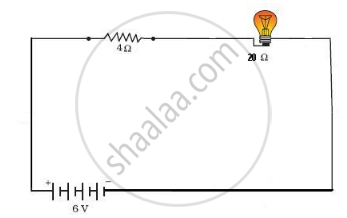
(a) Total resistance, R = 20 Ω + 4 Ω = 24 Ω
(b) Current through the circuit,
I = V/R
I = 6/24
I = 0.25 A
(c) Potential difference across the electric bulb,
Vbulb = IRbulb
`=0.25xx20`
= 5 V
(d) Potential difference across the resistance wire,
Vwire = IRwire
`= 0.25xx4`
= 1 V
APPEARS IN
संबंधित प्रश्न
Three 2 V cells are connected in series and used as a battery in a circuit.
- What is the p.d. at the terminals of the battery?
- How many joules of electrical energy does 1 C gain on passing through
- one cell
- all three cells?
Three 2 V cells are connected in series and used as a battery in a circuit.
How many joules of electrical energy does 1 C gain on passing through (i) one cell (ii) all three cells?
Which of the two is connected in series : ammeter or voltmeter?
Fill in the folloing blank with suitable words:
A current is a flow of ............... .For this to happen there must be a ............... circuit.
State the factors on which the strength of electric current flowing in a given conductor depends.
A switch must be connected in ______.
What is the purpose of a fuse in an electrical circuit?
State whether the current is a scalar or vector?
Answer the following question.
What is the function of a galvanometer in a circuit?
State the condition when it is advantageous to connect cells in parallel.
Three resistances, of which two are equal when connected in series have an effective resistance of 30 ohms. When the three resistances are connected in parallel, the effective resistances is 3 ohms. Find the values of the individual resistances.
Conventionally, the direction of the current is taken as:
Coulomb is the SI unit of ____________.
