Advertisements
Advertisements
प्रश्न
In the network shown in the following adjacent Figure, calculate the equivalent resistance between the points.
- A and B
- A and C

Advertisements
उत्तर
(a) Rs = r1 + r2 + r3
Rs = 2 + 2 + 2
Rs = 6 Ω
`"R"_1` and `"R"_2` are connected in parallel
`1/"R"=1/"R"_"s"+1/"r"_4 = 1/6 + 1/2 = 4/6 " i.e." 2/3`
R = `3/2`
R = 1.5 Ω
(b) `"R"_("s"_1) = "r"_1 + "r"_2`
`"R"_("s"_1)` = 2 + 2 = 4 Ω
`"R"_("s"_2)` = r3 + r4 = 2 + 2 = 4 Ω
`"R"_1` and `"R"_2` are connected in parallel
`1/"R" =1/"R"_("s"_1) + 1/"R"_("s"_2)`
`1/"R" = 1/4 + 1/4`
`1/"R" = 2/4 ~~ 1/2`
R = 2 Ω
APPEARS IN
संबंधित प्रश्न
Why should the resistance of:
an ammeter be very small?
How many electrons are flowing per second past a point in a circuit in which there is a current of 5 amp?
What happens to the other bulbs in a series circuit if one bulb blows off?
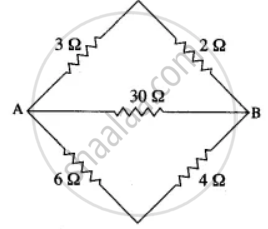
Calculate the equivalent resistance between A and B in the adjacent diagram.
Define the following:
Semiconductors
Calculate the current through a 60 W lamp rated 250 V. If the line voltage falls to 200 V, how is power consumed by the bulb affected?
An electric bulb is rated at 220 V, 100 W.
- What is its resistance?
- What safe current can be passed through it?
Three heaters each rated 250 W, 100 V are connected in parallel to a 100 V supply. Calculate :
The total current taken from the supply
A bulb is connected to a battery of p.d. 4 V and internal resistance 2.5 Ω . A steady current of 0.5 A flows through the circuit. Calculate:
The energy dissipated in the bulb in 10 minutes.
