Advertisements
Advertisements
प्रश्न
Advertisements
उत्तर
The direction of conventional current is taken as the direction of flow of positive charges.
The direction of electronic current is taken as opposite to the direction of motion of electrons.
APPEARS IN
संबंधित प्रश्न
One coulomb of charge flows through any cross-section of a conductor in 1 second. What is the current flowing through the conductor?
The p.d. across a 3 Ω resistor is 6 V. The current flowing in the resistor will be:
(a) `1/2A`
(b) 1 A
(c) 2 A
(d) 6 A
Find the potential difference required to pass a current of 0.2 A in a wire of resistance 20Ω
A strong short bar magnet is dropped into a solenoid connected to a
galvanometer as shown in fig. The galvanometer shows a deflection to the left when the current in the coil as seen from above is counter clockwise. Which one of the following shows the correct deflection of the galvanometer when the magnet is at posi tions A, Band C.
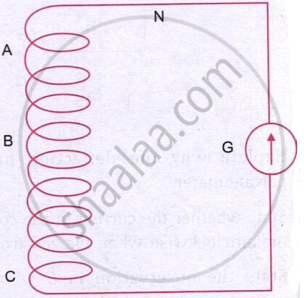
Tick (✓) the correct choice among the following :
Which of the following changes would enable a millimeter to be used as a
direct current ammeter reading upto 1 A?
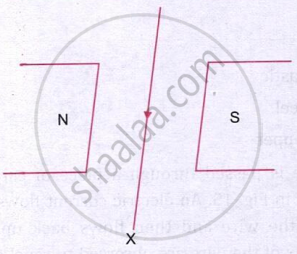
In fig. XY is at right angles to the magnetic field. The direction in which XY should be moved to induce an electron flow in the direction Y to X as indicated by the arrow is:
A geyser is rated 1500 W, 250 V. This geyser is connected to 250 V mains. Calculate:
- The current drawn,
- The energy consumed in 50 hours, and
- The cost of energy consumed at ₹ 4.20 per kWh.
True or False – If False give the correct answer
The representation of the electric current is A
Name any two devices, which are working on the heating effect of the electric current.
