Advertisements
Advertisements
प्रश्न
Point out two differences between e.m.f. and potential difference as applied to electric circuits.
Advertisements
उत्तर
Electromotive force or e.m.f. of a cell is potential difference between its two electrodes when it is in open circuit, i.e., not sending current in the external circuit; while potential difference is the difference in potential between the terminals when the cell is in closed circuit or it is sending current in the given circuits, e.m.f. is always greater than potential difference or terminal voltage of a cell on account of energy being spent in driving charge through the circuit.
संबंधित प्रश्न
What is meant by saying that the potential difference between two points is 1 V?
What do the letters p.d. stand for?
How much work is done in moving a charge of 2 C across two points having a potential difference of 12 V?
Keeping the potential difference constant, the resistance of a circuit is halved. By how much does the current change?
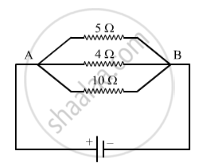
In the circuit diagram given below, the current flowing across 5 ohm resistor is 1 amp. Find the current flowing through the other two resistors.
Suppose there are three resistors A, B, and C having resistances r1, r2, and r3 respectively. If R represents their equivalent resistance, establish the following relation `1/"R" = 1/"r"_1 + 1/"r"_2 + 1/"r"_3`, when joined in parallel.
The figure shows a circuit. When the circuit is switched on, the ammeter reads 0.5 A.
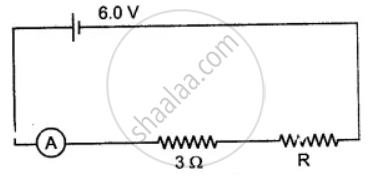
(i) Calculate the value of the unknown resistor R.
(ii) Calculate the charge passing through the 3 Ω resistor in 120 s.
(iii) Calculate the power dissipated in the 3 Ω resistor.
A 10 m long wire of a particular material is of reistance 5Ω What will be the resistance of 5m long wire of same material and the same thickness.
A current of 1 ampere flows in a series circuit containing an electric lamp and a conductor of 5 Ω when connected to a 10 V battery. Calculate the resistance of the electric lamp.
Now if a resistance of 10 Ω is connected in parallel with this series combination, what change (if any) in current flowing through 5 Ω conductor and potential difference across the lamp will take place? Give reason.
