Advertisements
Advertisements
प्रश्न
Suppose there are three resistors A, B, and C having resistances r1, r2, and r3 respectively. If R represents their equivalent resistance, establish the following relation R = r1 + r2 + r3 when joined in series.
Advertisements
उत्तर
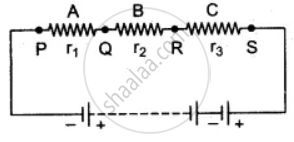
Let the three resistors be joined in series in given figure.
Let potential at P, Q, R and S are Vp, VQ, VR, and VS respectively and current i flows in the circuit.
Applying Ohm's law,
Vp + VQ = ir1 ...(i)
VQ - VR = ir2 ....(ii)
and VR - VS = ir3 ....(iii)
If the total effective resistance between P and S be R', then the potential difference:
VP - VR = iR' ....(A)
Adding (i), (ii) and (iii)
VP - VQ + VQ - VR + VR - VS = ir1 + ir2 + ir3
or VP - VS = i (r1 + r2 + r3) .... (B)
Comparing (A) and (B), we get
iR' = i (r1 + r2 + r3)
or R' = r1 + r2 + r3
संबंधित प्रश्न
What is meant by saying that the potential difference between two points is 1 V?
A battery of emf 12 V and internal resistance 2 Ω is connected with two resistors A and B of resistance 4 Ω and 6 Ω respectively joined in series.
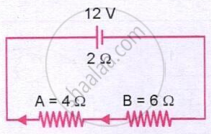
Find:
- Current in the circuit.
- The terminal voltage of the cell.
- The potential difference across 6Ω Resistor.
- Electrical energy spent per minute in the 4Ω resistor.
What is meant by saying that the electric potential at a point is 1 volt?
State the relation between potential difference, work done and charge moved.
Write down the formula which states the relation between potential difference, current, and resistance.
If the potential difference between the end of a wire of fixed resistance is doubled, by how much does the electric power increase?
Calculate the power used in the 2 Ω resistor in each of the following circuits: a 6 V battery in series with 1 Ω and 2 Ω resistors.
How is the electric potential difference between the two points defined? State its S.I. unit.
Three resistors are connected to a 6 V battery as shown in the figure given below:
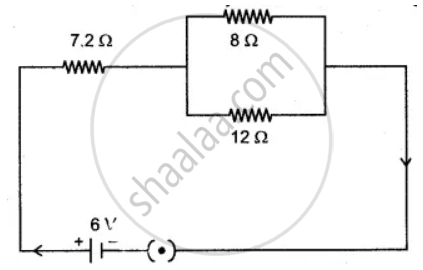
Calculate:
(i) the equivalent resistance of the circuit.
(ii) total current in the circuit.
(iii) potential difference across the 7.2 Ω resistor.
What does the positive and negative sign of potential convey?
