Advertisements
Advertisements
प्रश्न
Suppose there are three resistors A, B, and C having resistances r1, r2, and r3 respectively. If R represents their equivalent resistance, establish the following relation R = r1 + r2 + r3 when joined in series.
Advertisements
उत्तर
Let the three resistors be joined in series in given figure.
Let potential at P, Q, R and S are Vp, VQ, VR, and VS respectively and current i flows in the circuit.
Applying Ohm's law,
Vp + VQ = ir1 ...(i)
VQ - VR = ir2 ....(ii)
and VR - VS = ir3 ....(iii)
If the total effective resistance between P and S be R', then the potential difference:
VP - VR = iR' ....(A)
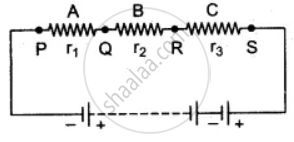
Adding (i), (ii) and (iii)
VP - VQ + VQ - VR + VR - VS = ir1 + ir2 + ir3
or VP - VS = i (r1 + r2 + r3) .... (B)
Comparing (A) and (B), we get
iR' = i (r1 + r2 + r3)
or R' = r1 + r2 + r3
संबंधित प्रश्न
State two causes of energy loss in a transformer.
Which device is used to measure p.d?
How much work is done in moving a charge of 2 C across two points having a potential difference of 12 V?
What is a voltmeter?
The p.d. across a lamp is 12 V. How many joules of electrical energy are changed into heat and light when: a current of 2 A flows through it for 10 s?
A current of 200 mA flows through a 4 kΩ resistor. What is the p.d. across the resistor?
Explain the statement ‘the potential difference between two points is 1 volt’.
A battery of 10 volt carries 20,000 C of charge through a resistance of 20 Ω. The work done in 10 seconds is:
Find out the following in the electric circuit given in Figure
- Effective resistance of two 8 Ω resistors in the combination
- Current flowing through 4 Ω resistor
- Potential difference across 4 Ω resistance
- Power dissipated in 4 Ω resistor
- Difference in ammeter readings, if any.

Electric potential is a measure of the ______ on the unit positive charge to bring it to that point against all electrical forces.
