Advertisements
Advertisements
प्रश्न
The device used for measuring potential difference is
पर्याय
Potentiometer
Ammeter
Galvanometer
Voltmeter
Advertisements
उत्तर
Voltmeter
APPEARS IN
संबंधित प्रश्न
What is the potential difference between the terminals of a battery if 250 joules of work is required to transfer 20 coulombs of charge from one terminal of battery to the other?
What is the ratio of potential difference and current known as?
A current of 200 mA flows through a 4 kΩ resistor. What is the p.d. across the resistor?
Write proper word from the following group of words in the blank.
(magnetism, 4.5V, 3.0V, gravitational attraction, potential difference, potential, higher, lower, 0V)
Water in the waterfall flows from a higher level to the lower level because of ______.
A current of 0.2 A flows through a wire whose ends are at a potential difference of 15 V. Calculate:
(i) The resistance of the wire, and
(ii) The heat energy produced in 1 minute.
Write an expression for the electrical power spent in flow of current through a conductor in terms of resistance and potential difference.
Find the resistance of a conductor if the electric current flowing through it is 0.35 A when the potential difference across it is 1.4 V.
The figure shows a circuit. When the circuit is switched on, the ammeter reads 0.5 A.
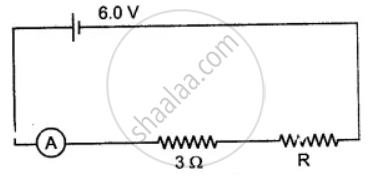
(i) Calculate the value of the unknown resistor R.
(ii) Calculate the charge passing through the 3 Ω resistor in 120 s.
(iii) Calculate the power dissipated in the 3 Ω resistor.
In the figure given below, A, B and C are three ammeters. The ammeter B reads 0.5A. (All the ammeters have negligible resistance.)
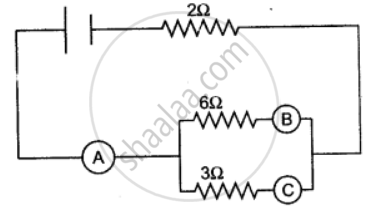
Calculate:
(i) the readings in the ammeters A and C.
(ii) the total resistance of the circuit.
Define electric potential and potential difference.
