Advertisements
Advertisements
प्रश्न
Conceptual question.
A bird sitting on a high power electric line is still safe. How?
Advertisements
उत्तर
Birds don’t get shocked when they sit on electrical wires because they are not good conductors of electricity. Electricity flowing through a single power line at 35,000 volts will continue along the path of least resistance and bypass birds, because there is no difference in electrical potential.
APPEARS IN
संबंधित प्रश्न
What is the unit of electric charge?
A current of 200 mA flows through a 4 kΩ resistor. What is the p.d. across the resistor?
For the circuit shown in the diagram below:
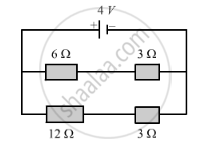
What is the value of:
(i) current through 6 Ω resistor?
(ii) potential difference across 12 Ω resistor?
Explain the statement ‘the potential difference between two points is 1 volt’.
Calculate the potential difference between the two terminals of a battery if 100 joules of work is required to transfer 20 coulombs of charge from one terminal of the battery to the other.
Suppose there are three resistors A, B, and C having resistances r1, r2, and r3 respectively. If R represents their equivalent resistance, establish the following relation `1/"R" = 1/"r"_1 + 1/"r"_2 + 1/"r"_3`, when joined in parallel.
A 10 m long wire of a particular material is of reistance 5Ω What will be the resistance of 5m long wire of same material and the same thickness.
A 10 m long wire of a particular material is of resistance 5Ω What will be the resistance if the wire is doubled itself.
A boy records that 4000 joules of work are required to transfer 10 coulombs of charge between two points of a resistor of 50 Ω. The current passing through it is:
