Advertisements
Advertisements
प्रश्न
Concave mirrors are used by dentists to examine teeth. Why?
Advertisements
उत्तर
As a dentist’s head mirror: You would have seen a circular mirror attached to a band tied to the forehead of the dentist/ENT specialist. A parallel beam of light is made to fall on the concave mirror; this mirror focuses the light beam on a small area of the body (such as teeth, throat etc.).
APPEARS IN
संबंधित प्रश्न
A spherical mirror produces an image of magnification −1 on a screen placed at a distance of 40 cm from the mirror:
(i) Write the type of mirror.
(ii) What is the nature of the image formed?
(iii) How far is the object located from the mirror?
(iv) Draw the ray diagram to show the image formation in this case.
Fill in the following blank with suitable word:
The focal length of a concave mirror is the distance from the ......... to the mirror.
Make labelled ray diagrams to illustrate the formation of:
a virtual image by a converging mirror.
Mark clearly the pole, focus, centre of curvature and position of object in each case.
The mirror which can form a magnified image of an object is:
(a) convex mirror
(b) plane mirror
(c) concave mirror
(d) both convex and concave mirror
The diagram shows a dish antenna which is used to receive television signals from a satellite. The antenna (signal detector) is fixed in front of the curved dish.
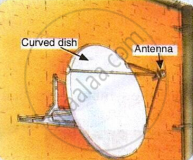
- What is the purpose of the dish?
- Should it be concave or convex?
- Where should the antenna be positioned to receive the strongest possible signals?
- Explain what change you would expect in the signals if a larger dish was used.
Name the lens which can concentrate sun's rays to a point and burn a hole in a piece of paper.
The image formed by a concave mirror is of the same size as the object, if the object is placed
A student obtained a sharp inverted image of a distant tree on a screen placed in front of the concave mirror. He then removed the screen and tried to look into the mirror. He would now see
(A) a very blurred image on the wall opposite to the mirror
(B) an erect and magnified image of the tree in the mirror
(C) no image as the screen has been removed
(D) a highly diminished inverted image of the tree at the focus of the mirror.
Between which two points of a concave mirror should an object be placed to obtain a magnification of -2?
Which type of mirror is used in the following?
Floodlights
