Advertisements
Advertisements
Question
Advertisements
Solution
One may get an electric shock from an electrical appliance if accidentally the live wire comes in contact with the metallic case of the body of the appliance due to break of insulation after constant use (or otherwise).
APPEARS IN
RELATED QUESTIONS
Choose the correct alternative and rewrite the following sentence.
When the resistance of a conductor increases, the current will ________ increase.
If the current through a floodlamp is 5 A, what charge passed in 10 seconds?
(a) 0.5 C
(b) 2 C
(c) 5 C
(d) 50 C
Tick(✓) the correct choice in the following:
Which of the following quantities has the same value for all electrical
appliances connected to the ring main circuit in a house?
Find the effective resistance in the following circuit diagrams (Fig.):
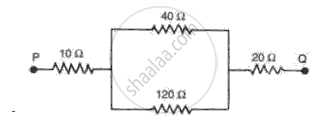
A bulb marked 12 V, 24 W operates on a 12 V battery for 20 minutes. Calculate:
- The current flowing through it, and
- The energy consumed.
Unit of electric power may also be expressed as
A charge of 400C flows through a conductor for 13 minutes and 20 seconds. Find the magnitude of the current flowing through the conductor.
Find the odd one out.
Loudspeaker, Bar magnet/magnet, Electric motor, Microphone.
Conventional current is defined as the direction in which which type of charge would flow?
