Advertisements
Advertisements
Question
Fig . shows the essent ial features of a battery operated bell. The hammer strikes the gong when the swi tch is closed . State and explain the effect of using the following material successively to form the core.
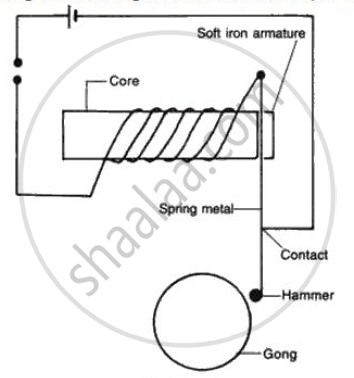
(a) Plastic
(b) Steel
(c) Copper
Advertisements
Solution
(a) Plastic being non-magnetic cannot be used as a material for core. It shall not intensify the formed magnetic field.
(b) Steel has high retentivity. Hence, after prolonged use even when the switch is off, it may retain some magnetic property and attract the armature.
(c) Using copper as a material for core will introduce eddy currents in the core and thus, interfere with the working of the bell.
RELATED QUESTIONS
What determines the rate at which energy is delivered by a current?
Which one has a higher electrical resistance : a 100 watt bulb or a 60 watt bulb?
An electric kettle for use on a 230 V supply is rated 3000 W. For safe working, the cable connected to it should be able to carry at least:
(a) 2 A
(b) 5 A
(c) 10 A
(d) 15 A
Distinguish between kilowatt and kilowatt-hour.
An electric bulb, when connected across a power supply of 220 V, consumes a power of 60 W. If the supply drops to 180 V, what will be the power consumed? If the supply is suddenly increased to 240 V, what will be the power consumed?
What is electric power? State and define its S.I. unit.
Point out two main disadvantages of ‘Tree System’.
Out of the three fuses with current ratings 5A, 10A, 15A, which one is to be connected in a geyser circuit marked 3 kW, 220V? Give reason for your answer.
Unit of electric power may also be expressed as:
