Advertisements
Advertisements
प्रश्न
You are provided with three resistors of resistance 1.0 Ω, 2.0 Ω and 3.0 Ω How would you connect them to obtain the total effective resistance 1.5 Ω? Draw diagram of the arrangement and check it by calculations.
Advertisements
उत्तर
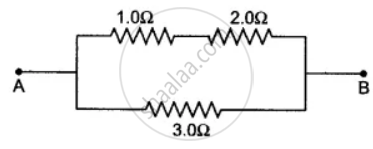
Two resistors of resistance 1.0 Ω and 2.0 Ω are connected in series and then this combination is connected in parallel with the resistor of resistance 3.0 Ω. The arrangement is shown in given figure alongside
Total resistance of series combination R = 1 + 2 = 3 Ω.
Total effective resistance of parallel combination
R = `(3 xx 3)/(3 + 3) = 1.5 Ω`
संबंधित प्रश्न
Why is the series arrangement not used for domestic circuits?
When a 4 Ω resistor is connected across the terminals of a 12 V battery, the number of coulombs passing through the resistor per second is:
(a) 0.3
(b) 3
(c) 4
(d) 12
Bends in a rubber pipe reduce the flow of water through it. How would the bands in a wire affect its electric resistance?
How does the resistivity of an alloy such as constantace depends on temperature.
State expression for Resistance connected in parallel.
State a relation between electrical power, resistance and potential difference in an electrical circuit.
In the circuit shown below, calculate the equivalent resistance between the points (i) A and B, (ii) C and D.
What should be the length of a nickel wire of area of cross-section 3 mm2 used for making a rheostat of 750 ohm? (ρ of nickle = 0.069 Ohm mm2/m)
In an electrical circuit, two resistors of 2 Ω and 4 Ω respectively are connected in series to a 6 V battery. The heat dissipated by the 4 Ω resistor in 5 s will be ______.
Show how you would connect three resistors, each of resistance 6 Ω, so that the combination has a resistance of 4 Ω.
