Advertisements
Advertisements
Question
You are provided with three resistors of resistance 1.0 Ω, 2.0 Ω and 3.0 Ω How would you connect them to obtain the total effective resistance 1.5 Ω? Draw diagram of the arrangement and check it by calculations.
Advertisements
Solution
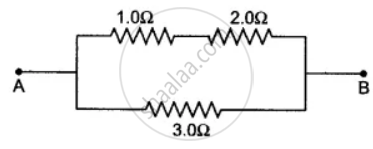
Two resistors of resistance 1.0 Ω and 2.0 Ω are connected in series and then this combination is connected in parallel with the resistor of resistance 3.0 Ω. The arrangement is shown in given figure alongside
Total resistance of series combination R = 1 + 2 = 3 Ω.
Total effective resistance of parallel combination
R = `(3 xx 3)/(3 + 3) = 1.5 Ω`
RELATED QUESTIONS
Find the expression for the resistors connected in series and write the two characteristics of it. (Draw figure).
Calculate the resistance of an aluminium cable of length 10 km and diameter 2.0 mm if the resistivity of aluminium is 27 × 10−8 Ωm.
Give the law of combination of resistances in series.
If two resistors of 25 Ω and 15 Ω are joined together in series and then placed in parallel with a 40 Ω resistor, the effective resistance of the combination is :
(a) 0.1 Ω
(b) 10 Ω
(c) 20 Ω
(d)40 Ω
State how are the two resistors joined with a battery when equivalent resistance is more than either of the two resistances.
How does the resistance of an alloy, vary with temperature?
Calculate the equivalent resistance between the points A and B for the following combination of resistors:
Illustrate-combination of cells e.g., three cells, in series, explaining the combination briefly. Obtain an expression for current ‘i’ in the combination.
Two electric bulbs have resistances in the ratio 1 : 2. If they are joined in series, the energy consumed in them is in the ratio:
