Advertisements
Advertisements
Question
The substance having infinitely high electrical resistance is called:
(a) conductor
(b) resistor
(c) superconductor
(d) insulator
Advertisements
Solution
(d) insulator
A substance having infinitely high electrical resistance is called an insulator.
APPEARS IN
RELATED QUESTIONS
A piece of wire of resistance R is cut into five equal parts. These parts are then connected in parallel. If the equivalent resistance of this combination is R’, then the ratio `"R"/"R'"` is ______.
Name the material which is the best conductor of electricity.
State the order of resistivity of (i) a metal, (ii) a semiconductor and (iii) an insulator.
Name a substance of which the resistance remains almost unchanged by the increase in temperature.
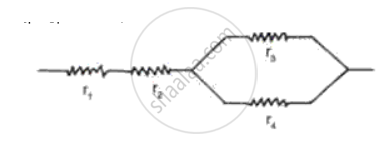
Calculate the equivalent resistance of the following combination of resistor r1, r2, r3, and r4
What do you mean by power rating of an electrical appliance? How do you use it to calculate
(a) the resistance of the appliance and
(b) the safe limit of the current in it, while in use?
State the effect of rise in temperature on the resistance of semi-conductors.
How does the resistivity of a semiconductor depend on temperature?
Write an expression for calculating electrical power in terms of current and resistance.
Calculate the equivalent resistance between P and Q from the following diagram:
Two resistors of 4Ω and 6Ω are connected in parallel to a cell to draw 0.5 A current from the cell.
Draw a labelled circuit diagram showing the above arrangement.
With the help of a circuit diagram derive the formula for the resultant resistance of three resistances connected:
- in series and
- in parallel
If the current I through a resistor is increased by 100% (assume that temperature remains unchanged), the increase in power dissipated will be:
