Advertisements
Advertisements
Question
Advertisements
Solution
APPEARS IN
RELATED QUESTIONS
Give one example to show how the resistance depends on the nature of material of the conductor.
Calculate the resistance of an aluminium cable of length 10 km and diameter 2.0 mm if the resistivity of aluminium is 27 × 10−8 Ωm.
If two resistors of 25 Ω and 15 Ω are joined together in series and then placed in parallel with a 40 Ω resistor, the effective resistance of the combination is :
(a) 0.1 Ω
(b) 10 Ω
(c) 20 Ω
(d)40 Ω
Calculate the equivalent resistance of the following combination of resistor r1, r2, r3, and r4
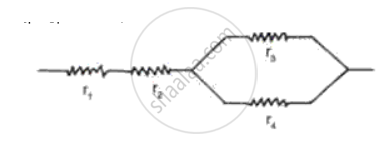
Bends in a rubber pipe reduce the flow of water through it. How would the bands in a wire affect its electric resistance?
Define the term resistivity and state its S.I. unit. Which will have higher resistivity a conductor or an insulator.
State and explain the laws of resistance.
Three resistors of 6Ω, 3Ω and 2Ω are connected together so that their total resistance is greater than 6Ω but less than 8Ω Draw a diagram to show this arrangement and calculate its total resistance.
If the current I through a resistor is increased by 100% (assume that temperature remains unchanged), the increase in power dissipated will be:
Consider the following combinations of resistors:


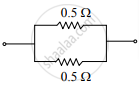
The combinations having equivalent resistance 1 Q is/are ______.
