Advertisements
Advertisements
प्रश्न
Draw a V-I graph for a conductor at two different temperatures. What conclusion do you draw from your graph for the variation of resistance of conductor with temperature?
Advertisements
उत्तर

In the above graph, T1 > T2. The straight line A is steeper than line B, which leads us to conclude that the resistance of a the conductor is more at high-temperature T1 than at low-temperature T2. Thus, we can say that the resistance of a conductor increases with an increase in temperature.
APPEARS IN
संबंधित प्रश्न
Complete the following :-
(a)

Find the expression for resistors connected in series.
A piece of wire of resistance R is cut into five equal parts. These parts are then connected in parallel. If the equivalent resistance of this combination is R’, then the ratio `"R"/"R'"` is ______.
When a 4 Ω resistor is connected across the terminals of a 12 V battery, the number of coulombs passing through the resistor per second is:
(a) 0.3
(b) 3
(c) 4
(d) 12
A p.d. of 4 V is applied to two resistors of 6 Ω and 2 Ω connected in series. Calculate:
(a) the combined resistance
(b) the current flowing
(c) the p.d. across the 6 Ω resistor
The diagram below shows part of a circuit:
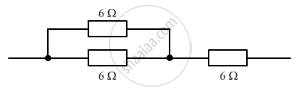
If this arrangement of three resistors was to be replaced by a single resistor, its resistance should be:
(a) 9 Ω
(b) 4 Ω
(c) 6 Ω
(d) 18 Ω
Write an expression for the resistance of a conducting wire in terms of its length and area of cross-section.
Define the term resistivity and state its S.I. unit. Which will have higher resistivity a conductor or an insulator.
State expression for Resistance connected in series.
