Advertisements
Advertisements
प्रश्न
State a relation between electrical power, resistance and potential difference in an electrical circuit.
Advertisements
उत्तर
In an electrical circuit, electrical power
P = V2/R
where V = potential difference and R = resistance.
APPEARS IN
संबंधित प्रश्न
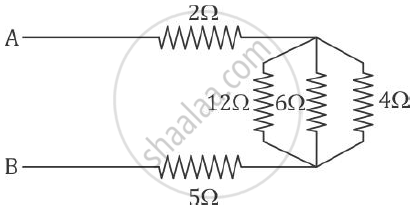
Find the equivalent resistance between points A and B.
(i) Two sets A and B, of three bulbs each, are glowing in two separate rooms. When one of the bulbs in set A is fused, the other two bulbs also cease to glow. But in set B, when one bulb fuses, the other two bulbs continue to glow. Explain why this phenomenon occurs.
(ii) Why do we prefer arrangements of Set B for house circuiting?
What possible values of resultant resistance one can get by combining two resistances, one of value 2 ohm and the other 6 ohm?
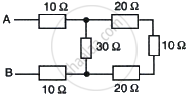
What is the resistance between A and B in the figure given below?
What potential difference is needed to drive a current o f 1 A through a 5 Ω resistor?
Calculate the equivalent resistance between P and Q from the following diagram:
2Ω resistor A, 1Ω resistor B and 4Ω resistor C are connected in parallel. The combination is connected across a 2V battery of negligible resistance. Draw the diagram of the arrangement and calculate:
(i) The current in each resistor A and C,
(ii) The current through battery.
The resistance of the hot filament of the bulb is about 10 times the cold resistance. What will be the resistance of 100 W-220 V lamps, when not in use?
What is the maximum resistance which can be made using five resistors each of `1/5` W?
