Advertisements
Advertisements
प्रश्न
Advertisements
उत्तर
A/c toOhm's law
R = `"V"/"I"`
Here V = 0.1 volt and I = 2 A
R = `0.1/2` = 0.05Ω
APPEARS IN
संबंधित प्रश्न
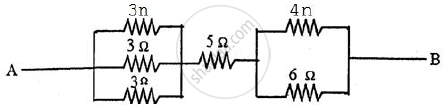
Find the equivalent resistance between points A and B
A p.d. of 4 V is applied to two resistors of 6 Ω and 2 Ω connected in series. Calculate:
(a) the combined resistance
(b) the current flowing
(c) the p.d. across the 6 Ω resistor
What is (a) highest, and (b)Ω lowest, resistance which can be obtained by combining four resistors having the following resistances?
4 Ω, 8 Ω, 12 Ω, 24 Ω
You have three resistors of values 2 `Omega`, 3 `Omega`, and 5 `Omega`. How will you join them so that the total resistance is less than 2 `Omega`?
Choose the correct alternative and rewrite the following:
You are given three equal resistances. In how many combinations can they are arranged?
Answer the following question.
While studying the dependence of potential difference ( V) across a resistor on the current (I) passing through it, in order to determine the resistance of the resistor, a student took 5 readings for different values of current and plotted a graph between V and t. He got a straight line graph passing through the origin. What does the straight-line signify? Write the method of determining the resistance of the resister using this graph.
Why are thick copper wires used as connecting wires?
What is a resistance? Define it with respect to Ohm’s law,
Calculate the equivalent resistance between P and Q from the following diagram:
In an electrical circuit, two resistors of 2 Ω and 4 Ω respectively are connected in series to a 6 V battery. The heat dissipated by the 4 Ω resistor in 5 s will be ______.
