Advertisements
Advertisements
प्रश्न
Advertisements
उत्तर
A/c toOhm's law
R = `"V"/"I"`
Here V = 0.1 volt and I = 2 A
R = `0.1/2` = 0.05Ω
APPEARS IN
संबंधित प्रश्न
If the equivalent resistance is to be increased, then the number of resistances should be connected in
- Series
- Parallel
- Mixed arrangement
- None of the above
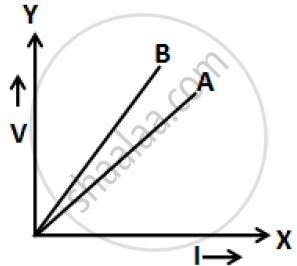
The V-I graph for a series combination and for a parallel combination of two resistors is shown in the figure below. Which of the two A or B. represents the parallel combination? Give reasons for your answer.
The substance having infinitely high electrical resistance is called:
(a) conductor
(b) resistor
(c) superconductor
(d) insulator
What possible values of resultant resistance one can get by combining two resistances, one of value 2 ohm and the other 6 ohm?
In series combination of resistances ______.
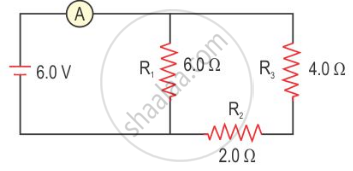
Three resistors of 6.0 Ω, 2.0 Ω and 4.0 Ω are joined to an ammeter A and a cell of emf 6.0 V as shown in the following figure. Calculate :
- the effective resistance of the circuit.
- the reading of ammeter.
A given metallic wire of resistance R is doubled on itself. What will be its new resistance?
How does the resistance of an alloy, vary with temperature?
Why are thick copper wires used as connecting wires?
Two lamps of resistance 30Ω and 20Ω respectively are connected in series in a 110V circuit. Calculate:
(i) the total resistance in the circuit
(ii) the current in the circuit, and
(iii) the voltage drop across each lamp.
