Advertisements
Advertisements
प्रश्न
A simple electric circuit has a 30 V battery and a resistor of 60 Ω. What will be the current in the circuit? The resistance of the connecting wires is negligible.
Advertisements
उत्तर
Given: Potential difference (V) = 30 V
Resistance (R) = 60 Ω
Find: Current (I) = ?
Formula: By Ohm’s law,
\[ I=\frac{V}{R} \]
\[ I=\frac{30}{60}=0.5\text{ A} \]
APPEARS IN
संबंधित प्रश्न
What determines the rate at which energy is delivered by a current?
What is the meaning of the symbol kWh? Which quantity does it represent?
An electric bulb is rated ‘100 W, 250 V’. How much current will the bulb draw if connected to a 250 V supply?
An electric bulb marked 220 V, 100 W will get fused if it is made to consume 150 W or more. What voltage fluctuation will the bulb withstand?
The coil of an electric bulb takes 40 watts to start glowing. If more than 40 W are supplied, 60% of the extra power is converted into light and the remaining into heat. The bulb consumes 100 W at 220 V. Find the percentage drop in the light intensity at a point if the supply voltage changes from 220 V to 200 V.
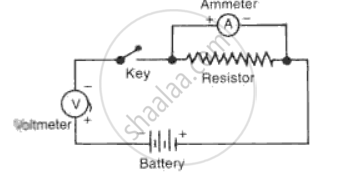
What is wrong with the circuit diagram (Fig. 34)? Carefully check the symbols and assign proper positive and negative signs to them.
State the position of heating element with respect to principal focus of concave reflector and give reason for choosing this position.
A device is used to transform 12 V a.c. to 200 V a.c. What is the name of this device? Name the principle on which it works.
How does the heat produced by die passage of current in a metallic wire depend on the resistance of the wire.
