Advertisements
Advertisements
प्रश्न
Calculate the value of the resistance which must be connected to a 15 ohm resistance to provide on effective resistance of 6 ohm.
Advertisements
उत्तर
Resistance decreases in parallel combination. S let R resistance is connected to 15 Ω resistance parallel to make resultant 6 ohm.
Now, `1/6 = 1/15 + 1/"R"`
or `1/"R" = 1/6 - 1/15`
`= (5 - 2)/30 = 3/30 = 1/10`
∴ R = 10 Ω
APPEARS IN
संबंधित प्रश्न
Calculate the resistance of an aluminium cable of length 10 km and diameter 2.0 mm if the resistivity of aluminium is 27 × 10−8 Ωm.
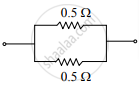
Calculate the combined resistance in the given case:

State the order of resistivity of (i) a metal, (ii) a semiconductor and (iii) an insulator.
Choose the correct alternative and rewrite the following:
You are given three equal resistances. In how many combinations can they are arranged?
Write an expression for the resistance of a conducting wire in terms of its length and area of cross-section.
You are provided with three resistors of resistance 1.0 Ω, 2.0 Ω and 3.0 Ω How would you connect them to obtain the total effective resistance 1.5 Ω? Draw diagram of the arrangement and check it by calculations.
Four resistances of 2.0Ω each are joined end to end, to form a square ABCD. Calculate the equivalent resistance of the combination between any two adjacent comers.
Illustrate-combination of cells e.g., three cells, in series, explaining the combination briefly. Obtain an expression for current ‘i’ in the combination.
The resistance of two resistors joined in series is 8Ω and in parallel is 1.5Ω. Find the value of the two resistances.
Consider the following combinations of resistors:


The combinations having equivalent resistance 1 Q is/are ______.
