Advertisements
Advertisements
Question
Why is the series arrangement not used for domestic circuits?
Advertisements
Solution
Series connections are not used in domestic electrical circuits due to the following reasons:
- It cannot be used with different devices (devices) with different switches on and off. If one equipment fails, the other also stops working.
- In series connection, the same current flows through all the devices, which we do not need.
- Due to high total resistance of the circuit (R = R1 + R2 + ...), the value of current becomes extremely low.
APPEARS IN
RELATED QUESTIONS
An electrical appliance has a resistance of 25 Ω. When this electrical appliance is connected to a 230 V supply line, the current passing through it will be:
(a) 0.92 A
(b) 2.9 A
(c) 9.2 A
(d) 92 A
The substance having infinitely high electrical resistance is called:
(a) conductor
(b) resistor
(c) superconductor
(d) insulator
Give one example to show how the resistance depends on the nature of material of the conductor.
Calculate the resistance of an aluminium cable of length 10 km and diameter 2.0 mm if the resistivity of aluminium is 27 × 10−8 Ωm.
What possible values of resultant resistance one can get by combining two resistances, one of value 2 ohm and the other 6 ohm?
The diagram below shows part of a circuit:
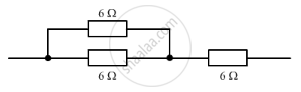
If this arrangement of three resistors was to be replaced by a single resistor, its resistance should be:
(a) 9 Ω
(b) 4 Ω
(c) 6 Ω
(d) 18 Ω
What potential difference is needed to drive a current o f 1 A through a 5 Ω resistor?
Two bulbs of 100 W and 40 W are connected in series. The current through the 100 W bulb is 1 A. The current through the 40 W bulb will be ______.
What is a resistance? Define it with respect to Ohm’s law,
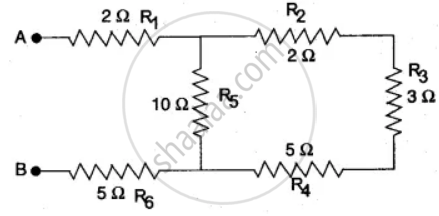
Six resistances are connected together as shown in the figure. Calculate the equivalent resistance between points A and B.
Four resistances of 2.0Ω each are joined end to end, to form a square ABCD. Calculate the equivalent resistance of the combination between any two adjacent comers.
2Ω resistor A, 1Ω resistor B and 4Ω resistor C are connected in parallel. The combination is connected across a 2V battery of negligible resistance. Draw the diagram of the arrangement and calculate:
(i) The current in each resistor A and C,
(ii) The current through battery.
Illustrate-combination of cells e.g., three cells, in series, explaining the combination briefly. Obtain an expression for current ‘i’ in the combination.
Illustrate-combination of cells e.g., three cells, in parallel, explaining the combination briefly. Obtain an expression for current ‘i’ in the combination.
Two wires of the same length and area made of two materials of resistivity ρ1 and ρ2 are connected in series to a source of potential V. The equivalent resistivity for the same area is:
When a 4 Ω resistor is connected across the terminals of a 2 V battery, the number of coulombs passing through the resistor per second is:
Two electric bulbs have resistances in the ratio 1 : 2. If they are joined in series, the energy consumed in them is in the ratio:
Consider the following combinations of resistors:


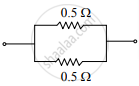
The combinations having equivalent resistance 1 Q is/are ______.
