Advertisements
Advertisements
Question
Why are the conductors of electric heating devices, such as bread-toasters and electric irons, made of an alloy rather than a pure metal?
Advertisements
Solution
The conductors of electric heating devices, such as bread toasters and electric irons, are made of alloy instead of pure metal for the following reasons:
- The resistivity of an alloy is higher than that of a metal, which produces a large amount of heat.
- Oxidation of alloys does not occur quickly at high temperatures.
- There is a negligible change in their resistance with an increase in temperature.
RELATED QUESTIONS
Name any two effects of electric current.
Give two reasons why nichrome alloy is used for making the heating elements of electrical appliances.
How does the resistance of a wire vary with its:
diameter?
A heating coil has a resistance of 200 Ω. At what rate will heat be produced in it when a current of 2.5 A flows through it?
Derive the expression for the heat produced due to a current 'I' flowing for a time interval 't' through a resistor 'R' having a potential difference 'V' across its ends. With which name is this relation known?
Three heaters each rated 250 W, 100 V are connected in parallel to a 100 V supply. Calculate:
- the total current taken from the supply
- the resistance of each heater and
- the energy supplied in kWh to the three heaters in 5 hours.
Give a scientific reason.
Tungsten metal is used to make a solenoid type coil in an electric bulb.
Give a scientific reason:
For electric power transmission, copper or aluminium wire is used.
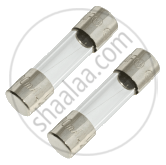
Identify the figure and give its use.
Give scientific reason :
In the electric equipment producing heat e.g. iron, electric heater, boiler, toaster, etc., an alloy such as Nichrome is used, not pure metals.
Compute the heat generated while transferring 96000 coulombs of charge in two hours through a potential difference of 40 V.
Explain the importance/uses of fuse wire.
Define fuse.
Explain the heating effect of electric current.
Why is parallel arrangement used in domestic wiring?
The following is not a safety device.
The electric fuse works on the Joule heating principle.
Explain why fuse wire is always connected in a series arrangement.
Define the following:
Electrolyte
Find the odd one out.
