Advertisements
Advertisements
Question
How does the resistance of an alloy, vary with temperature?
Advertisements
Solution
The resistance of an alloy remains nearly unaffected by the change in temperatue.
RELATED QUESTIONS
Write down an expression for the resistance of a metallic wire in terms of the resistivity.
Give the law of combination of resistances in series.
Name the following substance showing low resistivity.
Name the material of wire used for making standard resistances. Give a reason.
How does the resistivity of a semiconductor depend on temperature?
The voltage applied to a given rheostat is made four times its initial value. By what factor will be resistance of the rheostat change?
Calculate the equivalent resistance between the points A and B for the following combination of resistors:
Four resistances of 2.0Ω each are joined end to end, to form a square ABCD. Calculate the equivalent resistance of the combination between any two adjacent comers.
Calculate the quantity of heat that will be produced in a coil of resistance 75 Ω if a current of 2A is passed through it for 2 minutes.
Consider the following combinations of resistors:


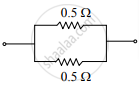
The combinations having equivalent resistance 1 Q is/are ______.
