Advertisements
Advertisements
Question
How does the resistance of a wire change when:
its length is tripled?
Advertisements
Solution
Resistance,
`R=l/A`
where l = length of wire
A= area of cross-section of the wire
When the length is tripled, l' = 3l
New resistance,
`R'=l/A `
`R'=(rho(3l))/A=(3l)/A`
`R=3R`
`R=P/A`
Thus, the resistance will become three times the original resistance.
APPEARS IN
RELATED QUESTIONS
Two resistors of 4Ω and 6 Ω are connected in parallel to a cell to draw 0.5 A current from the cell.
(i) Draw a labelled circuit diagram showing the above arrangement.
(ii) Calculate the current in each resistor. What is an Ohmic resistor?
If the length of a wire is doubled by taking more of wire, what happens to its resistance?
Name the material which is used for making the heating element of an electric iron.
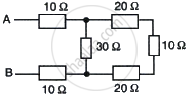
What is the resistance between A and B in the figure given below?
Name a substance of which the resistance remains almost unchanged by the increase in temperature.
How will you oonnect five resistors, each of the value one ohm, to obtain an equivalent resistance of 0.2 `Omega`
When do you say that the resistors are connected in this way? Draw a circuit diagram.
Bends in a rubber pipe reduce the flow of water through it. How would the bands in a wire affect its electric resistance?
Write an expression for calculating electrical power in terms of current and resistance.
2Ω resistor A, 1Ω resistor B and 4Ω resistor C are connected in parallel. The combination is connected across a 2V battery of negligible resistance. Draw the diagram of the arrangement and calculate:
(i) The current in each resistor A and C,
(ii) The current through battery.
Two resistors of 4Ω and 6Ω are connected in parallel to a cell to draw 0.5 A current from the cell. Calculate the current in each resistor.
Two wires of same material and same lengths have radii in the ratio of 2 : 3, Compare their resistances.
Two wires of the same length and area made of two materials of resistivity ρ1 and ρ2 are connected in series to a source of potential V. The equivalent resistivity for the same area is:
If the current I through a resistor is increased by 100% (assume that temperature remains unchanged), the increase in power dissipated will be:
When a 4 Ω resistor is connected across the terminals of a 2 V battery, the number of coulombs passing through the resistor per second is:
