Advertisements
Advertisements
प्रश्न
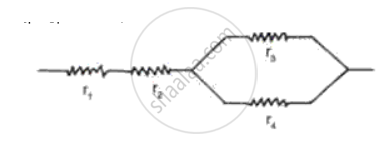
Calculate the equivalent resistance of the following combination of resistor r1, r2, r3, and r4
Advertisements
उत्तर १
In the given network, the series combination of resistors, r1 and r2 is connected in series with the parallel combination of resistors, r3 and r4
Equivalent resistance of resistor r1 and r2 , Rs= r1 + r2
Equivalent resistance of resistor r3 and r4 Rp = `[1/ "r"^3 + 1/"r"^4]^-1 = ("r"_3"r"_4)/("r"_3 + "r"_4)`
equivalent resistance of the given network, R = Rs + Rp = r1 + r2 + `("r"_3"r"_4)/("r"_3 + "r"_4)`
उत्तर २
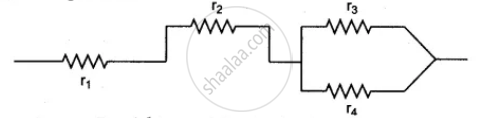
Since r3 and r4 are in parallel
∴ Equivalent resistance R1 of this combination is given by
`1/"R"_1 = 1/"r"_3 + 1/"r"_4 = ("r"_4 + "r"_3)/("r"_4 "r"_3)`
or R1 = `("r"_3 "r"_4)/("r"_3 + "r"_4)`
Now r1, r2 and R1 are in series
∴ Equivalent resistance R of the whole combination is
R = r1 + r2 + `("r"_3 "r"_4)/("r"_3 + "r"_4)`
= `(("r"_1 + "r"_2)("r"_3 + "r"_4) + "r"_3"r"_4)/("r"_3 + "r"_4) Omega`
APPEARS IN
संबंधित प्रश्न
A piece of wire of resistance R is cut into five equal parts. These parts are then connected in parallel. If the equivalent resistance of this combination is R’, then the ratio `"R"/"R'"` is ______.
An electrical appliance has a resistance of 25 Ω. When this electrical appliance is connected to a 230 V supply line, the current passing through it will be:
(a) 0.92 A
(b) 2.9 A
(c) 9.2 A
(d) 92 A
Name the material which is the best conductor of electricity.
You are supplied with a number of 100 Ω resistors. How could you combine some of these resistors to make a 250 Ω resistor?
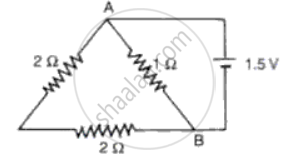
What is the equivalent resistance between A and B in the given circuit (Fig?)
Answer the following question.
While studying the dependence of potential difference ( V) across a resistor on the current (I) passing through it, in order to determine the resistance of the resistor, a student took 5 readings for different values of current and plotted a graph between V and t. He got a straight line graph passing through the origin. What does the straight-line signify? Write the method of determining the resistance of the resister using this graph.
Two bulbs of 100 W and 40 W are connected in series. The current through the 100 W bulb is 1 A. The current through the 40 W bulb will be ______.
Four resistances of 2.0Ω each are joined end to end, to form a square ABCD. Calculate the equivalent resistance of the combination between any two adjacent comers.
In the circuit shown below, calculate the equivalent resistance between the points (i) A and B, (ii) C and D.
