Advertisements
Advertisements
Question
Use Kirchhoff's rules to obtain conditions for the balance condition in a Wheatstone bridge.
Advertisements
Solution
Let us consider a Wheatstone bridge arrangement as shown below.
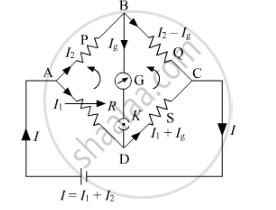
Applying Kirchhoff's loop law to the closed loop ADBA, we get
I1R−IgG−I2P=0 .....(1)
Here, G is the resistance of the galvanometer.
Applying Kirchhoff's loop law in the closed loop BDCB, we get
IgG+(I1+Ig)S−(I2−Ig)Q=0.....(2)
When the Wheatstone bridge is balanced, no current flows through the galvanometer, i.e. Ig=0
∴ From (1), we get
I1R−I2P=0
⇒I1R=I2P
`=>I_1/I_2=P/R" ......(3)"`
Similarly, from (2), we get
I1S−I2Q=0
⇒I1S=I2Q
`=>I_1/I_2=Q/S" .....(4)"`
From (3) and (4), we get
`P/R=Q/S`
or `P/Q=R/S`
This is the required balance condition in a Wheatstone bridge arrangement.
APPEARS IN
RELATED QUESTIONS
Kirchhoff's voltage law and current law are respectively in accordance with the conservation of .................................. .
- charge and momentum
- charge and energy
- energy and charge
- energy and momentum
State the two Kirchhoff’s rules used in electric networks. How are there rules justified?
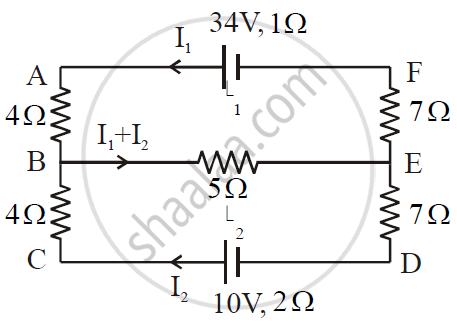
ε1 and ε2 are two batteries having emf of 34V and 10V respectively and internal resistance of 1Ω and 2Ω respectively. They are connected as shown in the figure below. Using Kirchhoff’s Laws of electrical networks, calculate the currents I1 and I2.
State Kirchhoff's rules for an electric network. Using Kirchhoff's rules, obtain the balance condition in terms of the resistances of four arms of Wheatstone bridge.
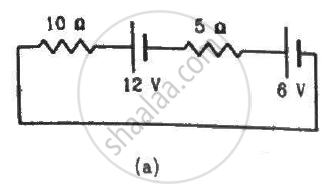
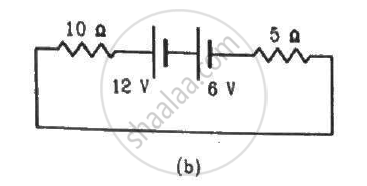
Consider the circuit shown in the figure. Find (a) the current in the circuit (b) the potential drop across the 5 Ω resistor (c) the potential drop across the 10 Ω resistor (d) Answer the parts (a), (b) and (c) with reference to the figure.
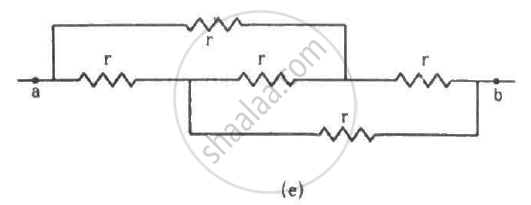
Find the equivalent resistances of the networks shown in the figure between the points a and b.
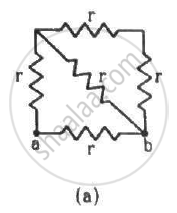
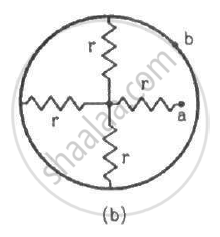
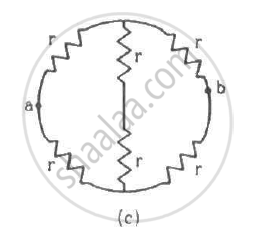
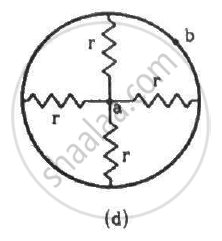
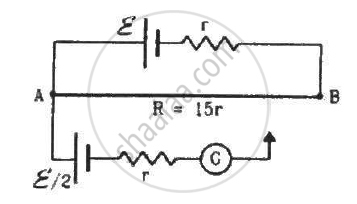
Consider the potentiometer circuit as arranged in the figure. The potentiometer wire is 600 cm long. (a) At what distance from the point A should the jockey touch the wire to get zero deflection in the galvanometer? (b) If the jockey touches the wire at a distance of 560 cm from A, what will be the current in the galvanometer?
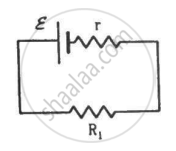
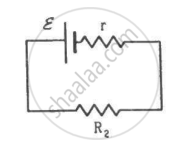
Two unequal resistances, R1 and R2, are connected across two identical batteries of emf ε and internal resistance r (see the figure). Can the thermal energies developed in R1 and R2 be equal in a given time? If yes, what will be the condition?
Twelve wires each having a resistance of 3 Ω are connected to form a cubical network. A battery of 10 V and negligible internal resistance is connected across the diagonally opposite corners of this network. Determine its equivalent resistance and the current along each edge of the cube.
State the principle of potentiometer.
State and explain Kirchhoff’s rules.
Obtain the condition for bridge balance in Wheatstone’s bridge.
While measuring the length of the rod by vernier callipers, the reading on the main scale is 6.4 cm and the eight divisions on vernier is in line with marking on the main scale division. If the least count of callipers is 0.01 and zero error - 0.04 cm, the length of the rod is ______.
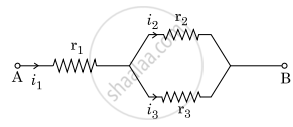
Three resistors having resistances r1, r2 and r3 are connected as shown in the given circuit. The ratio `"i"_3/"i"_1` of currents in terms of resistances used in the circuit is :
Why are alloys used for making standard resistance coils?
The circuit in figure shows two cells connected in opposition to each other. Cell E1 is of emf 6V and internal resistance 2Ω; the cell E2 is of emf 4V and internal resistance 8Ω. Find the potential difference between the points A and B.
Who gave Kirchhoff's laws?
Which mathematical form represents Kirchhoff's Current Law using an algebraic sum of currents?
At junction P, currents \[0.2\,\mathrm{A}\], \[0.6\,\mathrm{A}\], and \[0.7\,\mathrm{A}\] point towards P, while \[0.4\,\mathrm{A}\], \[0.5\,\mathrm{A}\], and \[I\] point away. What is the unknown current?
