Advertisements
Advertisements
प्रश्न
Deduce an expression for equivalent capacitance C when three capacitors C1, C2 and C3 connected in parallel.
Advertisements
उत्तर
An expression for effective capacitance in the parallel grouping of capacitors :
Consider three capacitors of capacitance C1 , C2 and C3 are connected in parallel.
Let Q1, Q2 and Q3 be the charges deposited on the capacitors as shown in the figure.
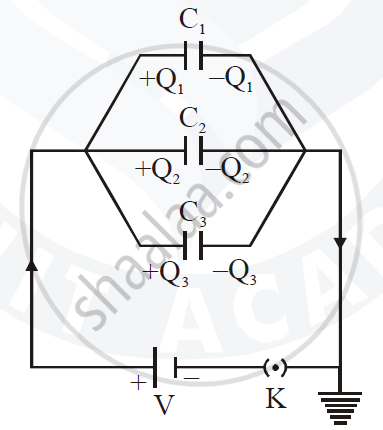
Suppose a potential difference ‘V ’ is applied across the combination. Then, the potential difference between the plates of each capacitor is V but charges on each capacitor are different. Since different current flows through different branches, so the charges are given by
`Q_1 = C_1V.Q_2 = C_2V. Q_3 = C_3V` ....(i)
From the principle of conservation of charge
`Q = Q_1 + Q_2 + Q_3`
`Q = C_1V + C_2V + C_3V` [From equation (i)]
`∴ Q = V(C_1 + C_2 + C_3)`
If these capacitors are replaced by a single capacitor of capacity CP such that `Q = C_PV` then using equation (ii) we have,
`C_PV = V(C_1+C_2+C_3)`
`C_P = C_1+C_2+C_3`
APPEARS IN
संबंधित प्रश्न
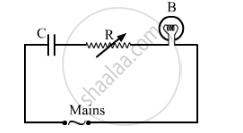
A capacitor 'C', a variable resistor 'R' and a bulb 'B' are connected in series to the ac mains in circuit as shown. The bulb glows with some brightness. How will the glow of the bulb change if (i) a dielectric slab is introduced between the plates of the capacitor, keeping resistance R to be the same; (ii) the resistance R is increased keeping the same capacitance?
Suppose a charge +Q1 is given to the positive plate and a charge −Q2 to the negative plate of a capacitor. What is the "charge on the capacitor"?
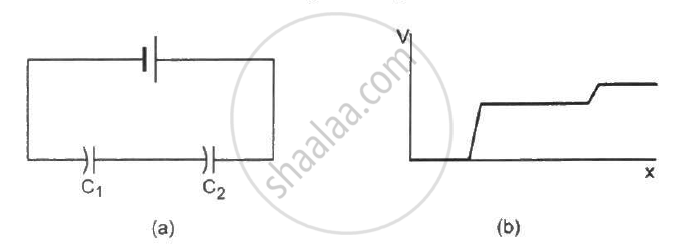
The following figure shows two capacitors connected in series and joined to a battery. The graph shows the variation in potential as one moves from left to right on the branch containing the capacitors.
Three capacitors of capacitance `C_1 = 3muf` , `C_2 = 6muf` , `C_3 = 10muf` , are connected to a 10V battery as shown in figure 3 below :
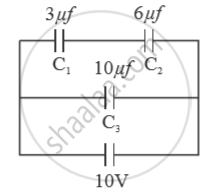
Calculate :
(a) Equivalent capacitance.
(b) Electrostatic potential energy stored in the system
Two parallel plate capacitors X and Y, have the same area of plates and same separation between plates. X has air and Y with dielectric of constant 2, between its plates. They are connected in series to a battery of 12 V. The ratio of electrostatic energy stored in X and Y is ______.
Two charges q1 and q2 are placed at (0, 0, d) and (0, 0, – d) respectively. Find locus of points where the potential a zero.
Three capacitors of capacitances 2 pF, 3 pF and 4 pF are connected in parallel. What is the total capacitance of the combination?
How is the total charge related to the charges on capacitors in parallel?
Compared with the individual capacitors in a parallel combination, how large is the equivalent capacitance?
What is the equivalent capacitance of \[n\] identical capacitors, each with capacitance \[C\], connected in parallel?
