Advertisements
Advertisements
प्रश्न
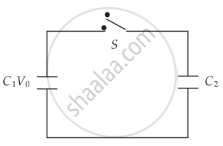
A capacitor of capacity C1 is charged to the potential of V0. On disconnecting with the battery, it is connected with an uncharged capacitor of capacity C2 as shown in the adjoining figure. Find the ratio of energies before and after the connection of switch S.
Advertisements
उत्तर
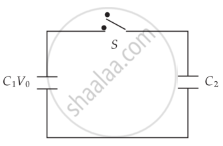
Before the connection of switch S,
Initial energy `U_i = 1/2C_1V_0^2 + 1/2C_2O^2 = 1/2C_1V_0^2`
After the connection of switch S,
common potential V = `(C_1V_1 + C_2V_2)/(C_1 + C_2) = (C_1V_0)/(C_1 + C_2)`
Final energy = `U_f = 1/2(C_1 + C_2) (C_1V_0)^2/(C_1 + C_2)^2 = 1/2 (C_1^2V_0^2)/((C_1 + C_2))`
`U_f : U_i = C_1/((C_1 + C_2))`
APPEARS IN
संबंधित प्रश्न
Figure 4 below shows a capacitor C, an inductor L and a resistor R, connected in series
to an a.c. supply of 220 V
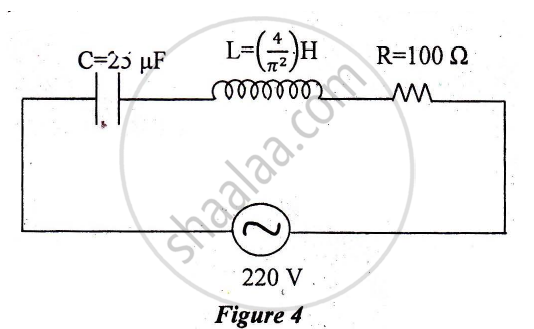
Calculate:
1) The resonant frequency of the given CLR circuit.
2) Current flowing through·the circuit.
3) Average power consumed by the circuit.
Suppose a charge +Q1 is given to the positive plate and a charge −Q2 to the negative plate of a capacitor. What is the "charge on the capacitor"?
The plates of a parallel-plate capacitor are given equal positive charges. What will be the potential difference between the plates? What will be the charges on the facing surfaces and on the outer surfaces?
Each plate of a parallel plate capacitor has a charge q on it. The capacitor is now connected to a batter. Now,
(a) the facing surfaces of the capacitor have equal and opposite charges
(b) the two plates of the capacitor have equal and opposite charges
(c) the battery supplies equal and opposite charges to the two plates
(d) the outer surfaces of the plates have equal charges
The separation between the plates of a charged parallel-plate capacitor is increased. Which of the following quantities will change?
(a) Charge on the capacitor
(b) Potential difference across the capacitor
(c) Energy of the capacitor
(d) Energy density between the plates
The plates of a capacitor are 2⋅00 cm apart. An electron-proton pair is released somewhere in the gap between the plates and it is found that the proton reaches the negative plate at the same time as the electron reaches the positive plate. At what distance from the negative plate was the pair released?
In the circuit shown in figure, initially K1 is closed and K2 is open. What are the charges on each capacitors.
Then K1 was opened and K2 was closed (order is important), What will be the charge on each capacitor now? [C = 1µF]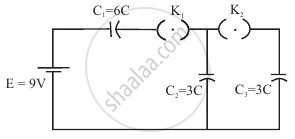
Two equal capacitors are first connected in series and then in parallel The ratio of the equivalent capacities in the two cases will be ______.
In the following circuit, the equivalent capacitance between terminal A and terminal B is:
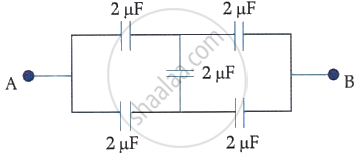
The equivalent capacitance of the combination shown is: