Advertisements
Advertisements
प्रश्न
Each plate of a parallel plate capacitor has a charge q on it. The capacitor is now connected to a batter. Now,
(a) the facing surfaces of the capacitor have equal and opposite charges
(b) the two plates of the capacitor have equal and opposite charges
(c) the battery supplies equal and opposite charges to the two plates
(d) the outer surfaces of the plates have equal charges
Advertisements
उत्तर
(a) the facing surfaces of the capacitor have equal and opposite charges
(b) the two plates of the capacitor have equal and opposite charges
(d) the outer surfaces of the plates have equal charges
In H.C Verma the answer is (a), (c) ,(d). But according to us the answer should be (a), (b), (d) all these options are the properties of a capacitor and the option (c) is incorrect because the battery is a source of energy not charge. Moreover if a capacitor plates have equal charge on outside and equal charge on inside then one can think that the charge on the plates must be also equal so option (b) cant be incorrect.
APPEARS IN
संबंधित प्रश्न
Two capacitors of unknown capacitances C1 and C2 are connected first in series and then in parallel across a battery of 100 V. If the energy stored in the two combinations is 0.045 J and 0.25 J respectively, determine the value of C1 and C2. Also calculate the charge on each capacitor in parallel combination.
Three capacitors of capacitance `C_1 = 3muf` , `C_2 = 6muf` , `C_3 = 10muf` , are connected to a 10V battery as shown in figure 3 below :
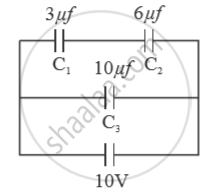
Calculate :
(a) Equivalent capacitance.
(b) Electrostatic potential energy stored in the system
A wire of resistance ‘R’ is cut into ‘n’ equal parts. These parts are then connected in parallel with each other. The equivalent resistance of the combination is:
Two parallel plate capacitors X and Y, have the same area of plates and same separation between plates. X has air and Y with dielectric of constant 2, between its plates. They are connected in series to a battery of 12 V. The ratio of electrostatic energy stored in X and Y is ______.
Capacitors connected in series have ______
The equivalent capacitance of the combination shown in the figure is ______.
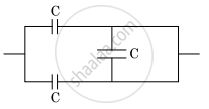
Two equal capacitors are first connected in series and then in parallel The ratio of the equivalent capacities in the two cases will be ______.
The total charge on the system of capacitors C1 = 1 µF, C2 = 2 µF, C3 = 4 µF and C4 = 3 µF connected in parallel is ______. (Assume a battery of 20 V is connected to the combination)
In the following circuit, the equivalent capacitance between terminal A and terminal B is:
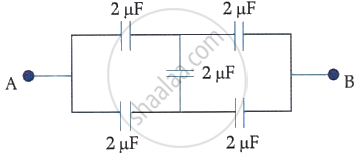
What is the work done per unit charge in moving a charge from one plate of a capacitor to the other called?
What is the charge relationship for capacitors in series?
Compared with the individual capacitors in a parallel combination, how large is the equivalent capacitance?
Which formula gives the equivalent capacitance of capacitors in parallel?
What is the equivalent capacitance of \[n\] identical capacitors, each with capacitance \[C\], connected in parallel?
Which expressions give the energy stored in series and parallel combinations, respectively?
Two capacitors with capacitances \[4\,\mu\mathrm{F}\] and \[4\,\mu\mathrm{F}\] are connected in parallel. What is their equivalent capacitance?
