Advertisements
Advertisements
प्रश्न
Two charges q1 and q2 are placed at (0, 0, d) and (0, 0, – d) respectively. Find locus of points where the potential a zero.
Advertisements
उत्तर
Following the principle of superposition of potentials as
described in last section, let us find the potential V due to a collection of discrete point charges q1, q2, …, qn, at a point P.
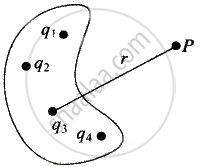
| The potential at P due to the system of point charges is given as the sum of their individual potentials at P, V = `1/(4piε_0) sum q_i/r_i` |
As we know, the potential at point P is V = `sumV_i`,
Where `V_i = q_i/(4piε_0) ; r_i` = magnitude of position vector P relative to qr
Then `V = 1/(4piε_0) sum q_i/r_"pi"`
Let us take a point on the required plane as (x, y, z). The two charges lies on z-axis at a separation of 2d. The potential at the point P due to two charge is given by
`q_1/(sqrt(x^2 + y^2 + (z - d)^2)) + q_2/(sqrt(x^2 + y^2 + (z + d)^2))` = 0
∴ `q_1/(sqrt(x^2 + y^2 + (z - d)^2)) = (-q_2)/(sqrt(x^2 + y^2 + (z + d)^2))`
On squaring and simplifying, we get
`x^2 + y^2 + z^2 + [((q_1/q_2)^2 + 1)/((q_1/q_2)^2 - 1)] (2zd) + d^2 - 0`
The standard equation of sphere is `x^2 + y^2 + z^2 + 2ux + 2uy + 2wz + g` = 0
With centre `(-u, -v, -w)` and radius `sqrt(u^2 + v^2 + w^2) - g`
Hence centre of sphere will be `(0, 0 - d[(q_1^2 + q_2^2)/(q_1^2 - q_2^2)])`
And radius is `r = sqrt((d[(q_1^2 + q_2^2)/(q_1^2 - q_2^2)])^2 - d^2) = (2q_1q_2d)/(q_1^2 - q_2^2)`
APPEARS IN
संबंधित प्रश्न
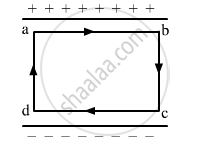
The electric field inside a parallel plate capacitor is E. Find the amount of work done in moving a charge q over a closed loop a b c d a.
Three capacitors of capacitances 2 pF, 3 pF and 4 pF are connected in parallel. Determine the charge on each capacitor if the combination is connected to a 100 V supply.
Deduce an expression for equivalent capacitance C when three capacitors C1, C2 and C3 connected in parallel.
The plates of a parallel-plate capacitor are given equal positive charges. What will be the potential difference between the plates? What will be the charges on the facing surfaces and on the outer surfaces?
The following figure shows two capacitors connected in series and joined to a battery. The graph shows the variation in potential as one moves from left to right on the branch containing the capacitors.
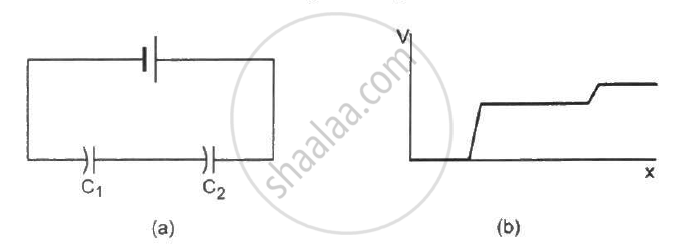
A parallel-plate capacitor is connected to a battery. A metal sheet of negligible thickness is placed between the plates. The sheet remains parallel to the plates of the capacitor.
Three capacitors of capacitance `C_1 = 3muf` , `C_2 = 6muf` , `C_3 = 10muf` , are connected to a 10V battery as shown in figure 3 below :
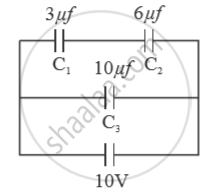
Calculate :
(a) Equivalent capacitance.
(b) Electrostatic potential energy stored in the system
An ac circuit consists of a series combination of circuit elements X and Y. The current is ahead of the voltage in phase by `pi/4`. If element X is a pure resistor of 100 Ω,
(a) name the circuit element Y.
(b) calculate the rms value of current, if rms of voltage is 141 V.
(c) what will happen if the ac source is replaced by a dc source
Two parallel plate capacitors X and Y, have the same area of plates and same separation between plates. X has air and Y with dielectric of constant 2, between its plates. They are connected in series to a battery of 12 V. The ratio of electrostatic energy stored in X and Y is ______.
In the circuit shown in figure, initially K1 is closed and K2 is open. What are the charges on each capacitors.
Then K1 was opened and K2 was closed (order is important), What will be the charge on each capacitor now? [C = 1µF]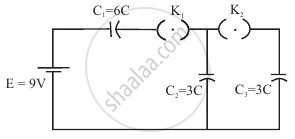
Two equal capacitors are first connected in series and then in parallel The ratio of the equivalent capacities in the two cases will be ______.
The total charge on the system of capacitors C1 = 1 µF, C2 = 2 µF, C3 = 4 µF and C4 = 3 µF connected in parallel is ______. (Assume a battery of 20 V is connected to the combination)
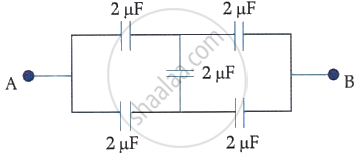
In the following circuit, the equivalent capacitance between terminal A and terminal B is:
What is the charge relationship for capacitors in series?
Which formula gives the equivalent capacitance of capacitors in series?
What is the equivalent capacitance of \[n\] identical capacitors, each with capacitance \[C\], connected in series?
In a series combination, which capacitor has the larger voltage drop?
Compared with the individual capacitors in a parallel combination, how large is the equivalent capacitance?
