Advertisements
Advertisements
प्रश्न
Two charges – q each are separated by distance 2d. A third charge + q is kept at mid point O. Find potential energy of + q as a function of small distance x from O due to – q charges. Sketch P.E. v/s x and convince yourself that the charge at O is in an unstable equilibrium.
Advertisements
उत्तर
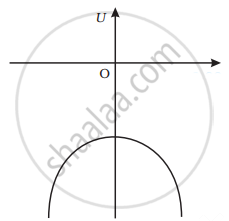
U = `1/(4piε_0) {(-q^2)/((d - x)) + (-q^2)/((d - x))}`
U = `(-q^2)/(4piε_0) (2d)/((d^2 - x^2))`
`(dU)/(dx) = (-q^2 . 2d)/(4piε_0) . (2x)/((d^2 - x^2)^2`
U0 = `(2q^2)/(4piε_0d) (dU)/(dx)` = 0 at x = 0
x = 0 is an equilibrium point.
`(d^2U)/(dx^2) = ((-2dq^2)/(4piε_0)) [2/((d^2 - x^2)^2) - (8x^2)/((d^2 - x^2)^3)]`
= `((-2dq^2)/(4piε_0)) 1/((d^2 - x^2)^3) [2(d^2 - x^2)^2 - 8x^2]`
At x = 0
`(d^2U)/(dx^2) = ((-2dq^2)/(4piε_0)) (1/d^6) (2d^2)`, which is < 0.
Hence, unstable equilibrium.
APPEARS IN
संबंधित प्रश्न
Considering the case of a parallel plate capacitor being charged, show how one is required to generalize Ampere's circuital law to include the term due to displacement current.
Define the capacitance of a capacitor. Obtain the expression for the capacitance of a parallel plate capacitor in vacuum in terms of plate area A and separation d between the plates.
In a parallel plate capacitor with air between the plates, each plate has an area of 6 × 10⁻³m2 and the separation between the plates is 3 mm.
- Calculate the capacitance of the capacitor.
- If this capacitor is connected to 100 V supply, what would be the charge on each plate?
- How would charge on the plates be affected, if a 3 mm thick mica sheet of k = 6 is inserted between the plates while the voltage supply remains connected?
A slab of material of dielectric constant K has the same area as that of the plates of a parallel plate capacitor but has the thickness d/2, where d is the separation between the plates. Find out the expression for its capacitance when the slab is inserted between the plates of the capacitor.
A slab of material of dielectric constant K has the same area as that of the plates of a parallel plate capacitor but has the thickness d/3, where d is the separation between the plates. Find out the expression for its capacitance when the slab is inserted between the plates of the capacitor.
Define the capacitance of a capacitor and its SI unit.
A parallel-plate capacitor has plate area 20 cm2, plate separation 1.0 mm and a dielectric slab of dielectric constant 5.0 filling up the space between the plates. This capacitor is joined to a battery of emf 6.0 V through a 100 kΩ resistor. Find the energy of the capacitor 8.9 μs after the connections are made.
A parallel plate air condenser has a capacity of 20µF. What will be a new capacity if:
1) the distance between the two plates is doubled?
2) a marble slab of dielectric constant 8 is introduced between the two plates?
Answer the following question.
Describe briefly the process of transferring the charge between the two plates of a parallel plate capacitor when connected to a battery. Derive an expression for the energy stored in a capacitor.
In a parallel plate capacitor, the capacity increases if ______.
A parallel plate capacitor is connected to a battery as shown in figure. Consider two situations:

- Key K is kept closed and plates of capacitors are moved apart using insulating handle.
- Key K is opened and plates of capacitors are moved apart using insulating handle.
Choose the correct option(s).
- In A: Q remains same but C changes.
- In B: V remains same but C changes.
- In A: V remains same and hence Q changes.
- In B: Q remains same and hence V changes.
A parallel plate capacitor filled with a medium of dielectric constant 10, is connected across a battery and is charged. The dielectric slab is replaced by another slab of dielectric constant 15. Then the energy of capacitor will ______.
What is a capacitor that consists of two large, parallel, conducting plates separated by a small distance called?
What is the surface charge density \[\sigma\] on a plate carrying charge \[Q\] over area \[A\]?
What is the effect of increasing plate area \[A\] on capacitance, and why?
When a dielectric slab of dielectric constant \[K\] is inserted between the plates, what is the electric field \[E'\] due to polarisation of the dielectric?
For the same voltage, what change allows more charge to be stored and more energy to be stored in the capacitor?
In electronic circuits, what are filters and oscillators used for?
How are capacitors used for energy storage in power supplies?
