Advertisements
Advertisements
प्रश्न
A parallel-plate capacitor with plate area 20 cm2 and plate separation 1.0 mm is connected to a battery. The resistance of the circuit is 10 kΩ. Find the time constant of the circuit.
Advertisements
उत्तर
Given:-
Area of the plates, A = 20 cm2 = 20 × 10−4 m2
Separation between the plates, d = 1 mm = 1 × 10⁻³ m,
Resistance of the circuit, R = 10 kΩ
The capacitance of a parallel-plate capacitor,
\[C = \frac{\in_0 A}{d}\]
\[ = \frac{8 . 85 \times {10}^{- 12} \times 20 \times {10}^{- 4}}{1 \times {10}^{- 3}}\]
\[ = \frac{8 . 85 \times {10}^{- 12} \times 2 \times {10}^{- 4}}{{10}^{- 3}}\]
\[ = 17 . 7 \times {10}^{- 12} F\]
Time constant = CR
= 17.7 × 10−12 × 10 × 103
= 17.7 × 10⁻⁸ s
= 0.177 × 10⁻⁶ s
= 0.18 μs
APPEARS IN
संबंधित प्रश्न
Draw a neat labelled diagram of a parallel plate capacitor completely filled with dielectric.
Show that the force on each plate of a parallel plate capacitor has a magnitude equal to `(1/2)` QE, where Q is the charge on the capacitor, and E is the magnitude of the electric field between the plates. Explain the origin of the factor `1/2`.
Define the capacitance of a capacitor. Obtain the expression for the capacitance of a parallel plate capacitor in vacuum in terms of plate area A and separation d between the plates.
A slab of material of dielectric constant K has the same area as the plates of a parallel plate capacitor but has a thickness \[\frac{3d}{4}\]. Find the ratio of the capacitance with dielectric inside it to its capacitance without the dielectric.
A ray of light falls on a transparent sphere with centre C as shown in the figure. The ray emerges from the sphere parallel to the line AB. Find the angle of refraction at A if the refractive index of the material of the sphere is \[\sqrt{3}\].
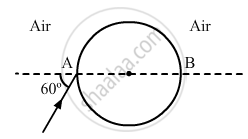
A slab of material of dielectric constant K has the same area as that of the plates of a parallel plate capacitor but has the thickness d/2, where d is the separation between the plates. Find out the expression for its capacitance when the slab is inserted between the plates of the capacitor.
A slab of material of dielectric constant K has the same area as that of the plates of a parallel plate capacitor but has the thickness 2d/3, where d is the separation between the plates. Find out the expression for its capacitance when the slab is inserted between the plates of the capacitor.
A parallel-plate capacitor has plate area 20 cm2, plate separation 1.0 mm and a dielectric slab of dielectric constant 5.0 filling up the space between the plates. This capacitor is joined to a battery of emf 6.0 V through a 100 kΩ resistor. Find the energy of the capacitor 8.9 μs after the connections are made.
For a one dimensional electric field, the correct relation of E and potential V is _________.
In a parallel plate capacitor, the capacity increases if ______.
Two identical capacitors are joined in parallel, charged to a potential V, separated and then connected in series, the positive plate of one is connected to the negative of the other. Which of the following is true?
A parallel plate capacitor filled with a medium of dielectric constant 10, is connected across a battery and is charged. The dielectric slab is replaced by another slab of dielectric constant 15. Then the energy of capacitor will ______.
What is the capacitance of a parallel plate capacitor with a dielectric medium of dielectric constant \[K\]?
For a large sheet of charge, what is the electric field due to each plate in terms of surface charge density \[\sigma\]?
Substituting \[V=\frac{Qd}{\varepsilon_0 A}\] into \[C=\frac{Q}{V}\] gives which capacitance?
What is the effect of increasing plate area \[A\] on capacitance, and why?
Where is electrical energy stored in a parallel plate capacitor, and how can it be used?
For the same voltage, what change allows more charge to be stored and more energy to be stored in the capacitor?
