Advertisements
Advertisements
प्रश्न
Define the capacitance of a capacitor. Obtain the expression for the capacitance of a parallel plate capacitor in vacuum in terms of plate area A and separation d between the plates.
Advertisements
उत्तर
The capacitance of a capacitor is the amount of charge which creates unit potential difference between collecting plate and condensing plate after giving charge on the collecting plate.
Parallel Plate Capacitor
-
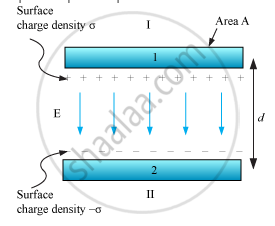
A parallel plate capacitor consists of two large plane parallel conducting plates separated by a small distance.
-
Let A be the area of each plate and d the separation between them. The two plates have charges Q and −Q.
-
Surface charge density of plate 1, σ = Q/A, and that of plate 2 is σ.
-
Electric field in different regions:
Outer region I,
`E = σ/(2ε_0) - σ/(2ε_0 ) = 0`
In the inner region between plates 1 and 2, the electric fields due to the two charged plates add up. So,
\[E = \frac{\sigma}{2 \epsilon_0} + \frac{\sigma}{2 \epsilon_0} = \frac{\sigma}{\epsilon_0} = \frac{Q}{\epsilon_0 A}\]
E=σ2ε0+σ2ε0=σε0=Qε0
-
The direction of electric field is from the positive to the negative plate.
-
For uniform electric field, potential difference is simply the electric field multiplied by the distance between the plates, i.e.
`V=Ed = 1/c (Qd)/A`
Capacitance C of the parallel plate capacitor in vacuum is
`C = Q/V =(ε_0A)/d `
APPEARS IN
संबंधित प्रश्न
Considering the case of a parallel plate capacitor being charged, show how one is required to generalize Ampere's circuital law to include the term due to displacement current.
In a parallel plate capacitor with air between the plates, each plate has an area of 6 × 10⁻³ m2 and the distance between the plates is 3 mm. Calculate the capacitance of the capacitor. If this capacitor is connected to a 100 V supply, what is the charge on each plate of the capacitor?
The plates of a parallel plate capacitor have an area of 90 cm2 each and are separated by 2.5 mm. The capacitor is charged by connecting it to a 400 V supply.
(a) How much electrostatic energy is stored by the capacitor?
(b) View this energy as stored in the electrostatic field between the plates, and obtain the energy per unit volume u. Hence arrive at a relation between u and the magnitude of electric field E between the plates.
A slab of material of dielectric constant K has the same area as that of the plates of a parallel plate capacitor but has the thickness d/3, where d is the separation between the plates. Find out the expression for its capacitance when the slab is inserted between the plates of the capacitor.
A parallel-plate capacitor is charged to a potential difference V by a dc source. The capacitor is then disconnected from the source. If the distance between the plates is doubled, state with reason how the following change:
(i) electric field between the plates
(ii) capacitance, and
(iii) energy stored in the capacitor
A parallel-plate capacitor is filled with a dielectric material of resistivity ρ and dielectric constant K. The capacitor is charged and disconnected from the charging source. The capacitor is slowly discharged through the dielectric. Show that the time constant of the discharge is independent of all geometrical parameters like the plate area or separation between the plates. Find this time constant.
A parallel plate capacitor is connected to a battery as shown in figure. Consider two situations:

- Key K is kept closed and plates of capacitors are moved apart using insulating handle.
- Key K is opened and plates of capacitors are moved apart using insulating handle.
Choose the correct option(s).
- In A: Q remains same but C changes.
- In B: V remains same but C changes.
- In A: V remains same and hence Q changes.
- In B: Q remains same and hence V changes.
A parallel plate capacitor filled with a medium of dielectric constant 10, is connected across a battery and is charged. The dielectric slab is replaced by another slab of dielectric constant 15. Then the energy of capacitor will ______.
Substituting \[V=\frac{Qd}{\varepsilon_0 A}\] into \[C=\frac{Q}{V}\] gives which capacitance?
How are capacitors used for energy storage in power supplies?
