Advertisements
Advertisements
प्रश्न
Answer the following question.
Describe briefly the process of transferring the charge between the two plates of a parallel plate capacitor when connected to a battery. Derive an expression for the energy stored in a capacitor.
Advertisements
उत्तर
Consider a parallel plate capacitor which is connected across a battery. As soon as the charges from the battery reach one plate, due to insulating gap charge is not able to move further to the other plate. Thus, the positive charge is developed at one plate and a negative charge is developed on the other. As the amount of charge increases on the plates, a voltage is developed across the capacitor that is opposite to the applied voltage. Hence, the current flowing in the circuit decreases and gradually becomes zero. Thus, the charge is developed on the capacitor.
Energy Stored in a Charged Capacitor
The energy of a charged capacitor is measured by the total work done in charging the capacitor to a given potential.
Let us assume that initially, both the plates are uncharged. Now, we have to repeatedly remove small positive charges from one plate and transfer them to the other plate.
Let
q → Total quantity of charge transferred
V → Potential difference between the two plates
Then
q = CV
Now, when an additional small charge dq is transferred from the negative plate to the positive plate, the small work done is given by,
`dW = Vdq = q/C dq`
The total work is done in transferring charge Q is given by,
`W = ∫_0^Q q/C dq = 1/C∫_0^Q qdq = 1/C[q^2/2]_0^Q`
`W = Q^2/(2C)`
This work is stored as electrostatic potential energy U in the capacitor.
`U = Q^2/(2C)`
`U = (CV)^2/(2C) ...[∵ Q = CV]`
`U = 1/2 CV^2`
संबंधित प्रश्न
The plates of a parallel plate capacitor have an area of 90 cm2 each and are separated by 2.5 mm. The capacitor is charged by connecting it to a 400 V supply.
(a) How much electrostatic energy is stored by the capacitor?
(b) View this energy as stored in the electrostatic field between the plates, and obtain the energy per unit volume u. Hence arrive at a relation between u and the magnitude of electric field E between the plates.
Show that the force on each plate of a parallel plate capacitor has a magnitude equal to `(1/2)` QE, where Q is the charge on the capacitor, and E is the magnitude of the electric field between the plates. Explain the origin of the factor `1/2`.
Define the capacitance of a capacitor. Obtain the expression for the capacitance of a parallel plate capacitor in vacuum in terms of plate area A and separation d between the plates.
A slab of material of dielectric constant K has the same area as the plates of a parallel plate capacitor but has a thickness \[\frac{3d}{4}\]. Find the ratio of the capacitance with dielectric inside it to its capacitance without the dielectric.
A ray of light falls on a transparent sphere with centre C as shown in the figure. The ray emerges from the sphere parallel to the line AB. Find the angle of refraction at A if the refractive index of the material of the sphere is \[\sqrt{3}\].
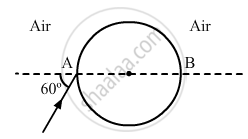
A slab of material of dielectric constant K has the same area as that of the plates of a parallel plate capacitor but has the thickness d/3, where d is the separation between the plates. Find out the expression for its capacitance when the slab is inserted between the plates of the capacitor.
A slab of material of dielectric constant K has the same area as that of the plates of a parallel plate capacitor but has the thickness 2d/3, where d is the separation between the plates. Find out the expression for its capacitance when the slab is inserted between the plates of the capacitor.
A parallel plate capacitor filled with a medium of dielectric constant 10, is connected across a battery and is charged. The dielectric slab is replaced by another slab of dielectric constant 15. Then the energy of capacitor will ______.
Substituting \[V=\frac{Qd}{\varepsilon_0 A}\] into \[C=\frac{Q}{V}\] gives which capacitance?
In electronic circuits, what are filters and oscillators used for?
