Advertisements
Advertisements
प्रश्न
Explain briefly the process of charging a parallel plate capacitor when it is connected across a d.c. battery
Advertisements
उत्तर
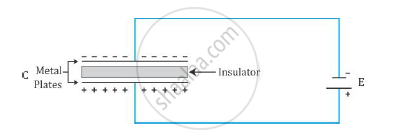
Consider a parallel plate capacitor connected across a d.c. battery as shown in the figure. The electric current will flow through the circuit. As the charges reach the plate, the insulating gap does not allow the charges to move further; hence, positive charges get deposited on one side of the plate and negative charges get deposited on the other side of the plate. As the voltage begins to develop, the electric charge begins to resist the deposition of further charge. Thus, the current flowing through the circuit gradually becomes less and then zero till the voltage of the capacitor is exactly equal but opposite to the voltage of the battery. This is how the capacitor gets charged when it is connected across a d.c. battery.
APPEARS IN
संबंधित प्रश्न
Considering the case of a parallel plate capacitor being charged, show how one is required to generalize Ampere's circuital law to include the term due to displacement current.
The plates of a parallel plate capacitor have an area of 90 cm2 each and are separated by 2.5 mm. The capacitor is charged by connecting it to a 400 V supply.
(a) How much electrostatic energy is stored by the capacitor?
(b) View this energy as stored in the electrostatic field between the plates, and obtain the energy per unit volume u. Hence arrive at a relation between u and the magnitude of electric field E between the plates.
A parallel-plate capacitor is filled with a dielectric material of resistivity ρ and dielectric constant K. The capacitor is charged and disconnected from the charging source. The capacitor is slowly discharged through the dielectric. Show that the time constant of the discharge is independent of all geometrical parameters like the plate area or separation between the plates. Find this time constant.
Answer the following question.
Describe briefly the process of transferring the charge between the two plates of a parallel plate capacitor when connected to a battery. Derive an expression for the energy stored in a capacitor.
Substituting \[V=\frac{Qd}{\varepsilon_0 A}\] into \[C=\frac{Q}{V}\] gives which capacitance?
What is the effect of increasing plate separation \[d\] on capacitance?
When the electric field is reduced to \[E'=\frac{E}{K}\] by a dielectric, what happens to potential difference and capacitance?
Where is electrical energy stored in a parallel plate capacitor, and how can it be used?
For the same voltage, what change allows more charge to be stored and more energy to be stored in the capacitor?
How are capacitors used for energy storage in power supplies?
