Advertisements
Advertisements
प्रश्न
Explain briefly the process of charging a parallel plate capacitor when it is connected across a d.c. battery
Advertisements
उत्तर
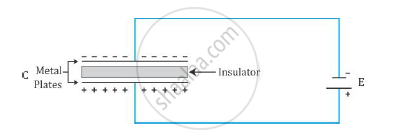
Consider a parallel plate capacitor connected across a d.c. battery as shown in the figure. The electric current will flow through the circuit. As the charges reach the plate, the insulating gap does not allow the charges to move further; hence, positive charges get deposited on one side of the plate and negative charges get deposited on the other side of the plate. As the voltage begins to develop, the electric charge begins to resist the deposition of further charge. Thus, the current flowing through the circuit gradually becomes less and then zero till the voltage of the capacitor is exactly equal but opposite to the voltage of the battery. This is how the capacitor gets charged when it is connected across a d.c. battery.
APPEARS IN
संबंधित प्रश्न
In a parallel plate capacitor with air between the plates, each plate has an area of 6 × 10⁻³ m2 and the distance between the plates is 3 mm. Calculate the capacitance of the capacitor. If this capacitor is connected to a 100 V supply, what is the charge on each plate of the capacitor?
A parallel plate capacitor is to be designed with a voltage rating 1 kV, using a material of dielectric constant 3 and dielectric strength about 107 Vm−1. (Dielectric strength is the maximum electric field a material can tolerate without breakdown, i.e., without starting to conduct electricity through partial ionisation.) For safety, we should like the field never to exceed, say 10% of the dielectric strength. What minimum area of the plates is required to have a capacitance of 50 pF?
In a parallel plate capacitor with air between the plates, each plate has an area of 6 × 10⁻³m2 and the separation between the plates is 3 mm.
- Calculate the capacitance of the capacitor.
- If this capacitor is connected to 100 V supply, what would be the charge on each plate?
- How would charge on the plates be affected, if a 3 mm thick mica sheet of k = 6 is inserted between the plates while the voltage supply remains connected?
A slab of material of dielectric constant K has the same area as that of the plates of a parallel plate capacitor but has the thickness 2d/3, where d is the separation between the plates. Find out the expression for its capacitance when the slab is inserted between the plates of the capacitor.
A parallel-plate capacitor has plate area 20 cm2, plate separation 1.0 mm and a dielectric slab of dielectric constant 5.0 filling up the space between the plates. This capacitor is joined to a battery of emf 6.0 V through a 100 kΩ resistor. Find the energy of the capacitor 8.9 μs after the connections are made.
In a parallel plate capacitor, the capacity increases if ______.
For two plates separated by distance \[d\], what is the capacitance of a parallel plate capacitor without a dielectric medium?
What is the capacitance of a parallel plate capacitor with a dielectric medium of dielectric constant \[K\]?
What is the effect of inserting a dielectric with \[K>1\] between the plates?
How are capacitors used for energy storage in power supplies?
