Advertisements
Advertisements
Question
Explain briefly the process of charging a parallel plate capacitor when it is connected across a d.c. battery
Advertisements
Solution
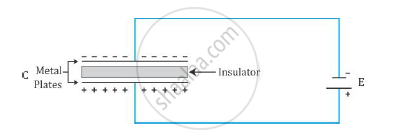
Consider a parallel plate capacitor connected across a d.c. battery as shown in the figure. The electric current will flow through the circuit. As the charges reach the plate, the insulating gap does not allow the charges to move further; hence, positive charges get deposited on one side of the plate and negative charges get deposited on the other side of the plate. As the voltage begins to develop, the electric charge begins to resist the deposition of further charge. Thus, the current flowing through the circuit gradually becomes less and then zero till the voltage of the capacitor is exactly equal but opposite to the voltage of the battery. This is how the capacitor gets charged when it is connected across a d.c. battery.
APPEARS IN
RELATED QUESTIONS
A slab of material of dielectric constant K has the same area as the plates of a parallel plate capacitor but has a thickness \[\frac{3d}{4}\]. Find the ratio of the capacitance with dielectric inside it to its capacitance without the dielectric.
A slab of material of dielectric constant K has the same area as that of the plates of a parallel plate capacitor but has the thickness d/2, where d is the separation between the plates. Find out the expression for its capacitance when the slab is inserted between the plates of the capacitor.
A slab of material of dielectric constant K has the same area as that of the plates of a parallel plate capacitor but has the thickness 2d/3, where d is the separation between the plates. Find out the expression for its capacitance when the slab is inserted between the plates of the capacitor.
Answer the following question.
Describe briefly the process of transferring the charge between the two plates of a parallel plate capacitor when connected to a battery. Derive an expression for the energy stored in a capacitor.
Solve the following question.
A parallel plate capacitor is charged by a battery to a potential difference V. It is disconnected from the battery and then connected to another uncharged capacitor of the same capacitance. Calculate the ratio of the energy stored in the combination to the initial energy on the single capacitor.
In a parallel plate capacitor, the capacity increases if ______.
Two identical capacitors are joined in parallel, charged to a potential V, separated and then connected in series, the positive plate of one is connected to the negative of the other. Which of the following is true?
Two charges – q each are separated by distance 2d. A third charge + q is kept at mid point O. Find potential energy of + q as a function of small distance x from O due to – q charges. Sketch P.E. v/s x and convince yourself that the charge at O is in an unstable equilibrium.
What is the effect of inserting a dielectric with \[K>1\] between the plates?
For the same voltage, what change allows more charge to be stored and more energy to be stored in the capacitor?
