Advertisements
Advertisements
Question
A slab of material of dielectric constant K has the same area as the plates of a parallel plate capacitor but has a thickness \[\frac{3d}{4}\]. Find the ratio of the capacitance with dielectric inside it to its capacitance without the dielectric.
Advertisements
Solution
\[\text { Capacitance of a capacitor without dielectric is given by }: \]
\[ C_o = \frac{\epsilon_o A}{d} . . . . . (i)\]
\[\text { Capacitance of capacitor when its plates are partly filled with dielectric of thickness t and of same area as the plates is given by }: \]
\[C = \frac{\epsilon_o A}{d - t (1 - \frac{1}{K})}\]
\[\text { Here} , t = \frac{3d}{4}\]
\[C = \frac{\epsilon_o A}{d - \frac{3d}{4}(1 - \frac{1}{K})} = \frac{\epsilon_o A}{\frac{dK + 3d}{4K}} = \frac{\epsilon_o A(4K)}{dK + 3d}\]
\[ = \frac{\epsilon_o A(4K)}{d(K + 3)} = \frac{4K}{(K + 3)} \times \frac{\epsilon_o A}{d}\]
\[\text { Therefore, the ratio of the capacitance with dielectric inside it to its capacitance without the dielectric is }\]
\[\frac{C_o}{C} = \frac{\frac{4K}{(K + 3)} \times \frac{\epsilon_o A}{d}}{\frac{\epsilon_o A}{d}} = \frac{4K}{(K + 3)}\]
APPEARS IN
RELATED QUESTIONS
Draw a neat labelled diagram of a parallel plate capacitor completely filled with dielectric.
Explain briefly the process of charging a parallel plate capacitor when it is connected across a d.c. battery
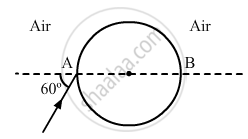
A ray of light falls on a transparent sphere with centre C as shown in the figure. The ray emerges from the sphere parallel to the line AB. Find the angle of refraction at A if the refractive index of the material of the sphere is \[\sqrt{3}\].
A slab of material of dielectric constant K has the same area as that of the plates of a parallel plate capacitor but has the thickness 2d/3, where d is the separation between the plates. Find out the expression for its capacitance when the slab is inserted between the plates of the capacitor.
Define the capacitance of a capacitor and its SI unit.
Two charges – q each are separated by distance 2d. A third charge + q is kept at mid point O. Find potential energy of + q as a function of small distance x from O due to – q charges. Sketch P.E. v/s x and convince yourself that the charge at O is in an unstable equilibrium.
What is the capacitance of a parallel plate capacitor with a dielectric medium of dielectric constant \[K\]?
Which description gives the working principle of a parallel plate capacitor?
In electronic circuits, what are filters and oscillators used for?
How are capacitors used for energy storage in power supplies?
