Advertisements
Advertisements
Question
State Faraday’s laws of electromagnetic induction.
Advertisements
Solution 1
First law: Whenever there is a change of magnetic flux in a closed circuit, an induced emf is produced in the circuit. This law is a qualitative law as it only indicates the characteristics of induced emf.
Second law: The magnitude of the induced emf produced in the circuit is directly proportional to the rate of change of the magnetic flux linked with the circuit. This law is known as the quantitative law, as it gives the magnitude of the induced emf.
Solution 2
Faraday’s First Law: Whenever the magnetic flux linked with a circuit changes, an emf is induced in the circuit.
Faraday’s Second Law: The magnitude of the induced emf is equal to the rate of change of magnetic flux.
e = `-(d phi)/dt`
For a coil of N turns:
e = `-N (d phi)/dt`
Negative sign indicates Lenz’s law (direction opposes cause).
APPEARS IN
RELATED QUESTIONS
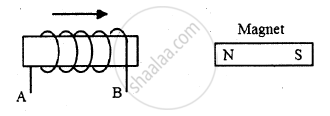
In the following diagram an arrow shows the motion of the coil towards the bar magnet.
(1) State in which direction the current flows, A to B or B to A?
(2) Name the law used to come to the conclusion.
- How would you demonstrate that a momentary current can be obtained by the suitable use of a magnet, a coil of wire and a galvanometer?
- What is the source of energy associated with the current obtained in part (a)?
- Describe briefly one way producing an induced e.m.f?
- State one factor that determines the magnitude of induced e.m.f. in part (a) above.
- What factor determines the direction of induced e.m.f. in part (a) above?
In which of the following case does the electromagnetic induction occur?
What is Lenz’s law?
Why does it become more difficult to move a magnet towards a coil when the number of turns in the coil has been increased?
The direction of induced current is obtained by ______.
Explain the principle, construction and working of a dc motor.
Faraday's law is the consequence of conservation of ______
The instantaneous magnetic flux in a circuit is `phi=4t^2-4t+1`. The total resistance of circuit is 15 Ω. At t = 2s, the induced current in circuit is ____________.
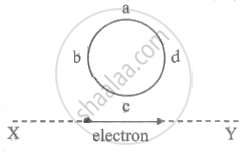
An electron moves on a straight line path XY as shown. The abed is a coil adjacent to the path of electron. What will be the direction of current, if any, induced in the coil?
A coil of 25 turns is pulled in 0.05 s between the poles of a magnet, where its area includes `21 xx106-6 "Wb" "to" 1 xx 10^-6 "Wb"`. The average e.m.f. is ______.
In a coil of resistance 150 `Omega`, a current is induced by changing the magnetic flux through it as shown in the figure. The magnitude of change in flux through the coil is ____________.

Magnetic flux passing through a coil is initially 6 x 10⁻⁴ Wb. It reduces to 10 % of its original value in 't' second. If the e.m.f. induced is 0.54 mV then 't' in second is ____________.
Fleming’s left hand and Right hand rules are used in ____________.
The direction of the magnetic field around a straight conductor carrying current can be determined by ______.
Fleming’s left-hand rule is also known as the dynamo rule.
Define the right-hand thumb rule.
A vertical electric field of magnitude 4.9 × 10⁵ N/C just prevents a water droplet of a mass 0.1 g from falling. The value of charge on the droplet will be: (Given g = 9.8 m/s2).
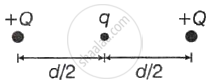
Two positively charged particles each having charge Q and are d distance apart. A third charge is introduced in midway on the line joining the two. Find nature and magnitude of third charge, so that the system is in equilibrium ______.
Express Faraday-Lenz's law of electromagnetic induction in an equation form.
A conductor in the form of a circular arc of the radius of curvature R subtends an angle Ø at its centre of curvature. If the current in the conduct is I, the magnetic induction at the centre of curvature is ______.
A circular loop is placed in a uniform magnetic field. The total number of magnetic field lines passing normally through the plane of the coil is called ______.
State the use of the principle of electromagnetic induction.
The magnetic flux through a coil perpendicular to its plane is varying according to the relation Φ = (5t3 + 4t2 + 2t − 5) Weber. If the resistant of the coil is 5 ohm, then the induced current through the coil at t = 2 sec will be ______.
An infinitely long cylinder is kept parallel to an uniform magnetic field B directed along positive z axis. The direction of induced current as seen from the z axis will be ______.
What did the experiments of Oersted, Ampere, and others establish about moving electric charges?
Under what condition is an electric current induced in a coil?
What is the current produced in a coil by changing magnetic flux called?
What does Faraday’s First Law or Neumann’s law state about the magnitude of induced emf?
If magnetic flux is measured in weber and time in seconds, what is the unit of induced emf?
What passes through a coil when the north pole of a magnet is near it?
What is the induced emf if both a magnet and a coil remain stationary?
What happens when changing magnetic flux passes through a coil that is an open circuit with infinite resistance?
What does induction in an open circuit show about the cause of induced emf?
What does the negative sign in Faraday’s First Law indicate?
What interaction opposes a north pole moving towards the near face of a coil?
Why must work be done to move a magnet towards or away from a coil when an induced current flows?
In Fleming’s Right-Hand Rule, which finger points in the direction of motion of the conductor?
In Fleming’s Right-Hand Rule, which finger gives the direction of the induced current?
If the magnetic field across a loop decreases to zero, what is the final magnetic flux through the loop?
