Advertisements
Advertisements
Question
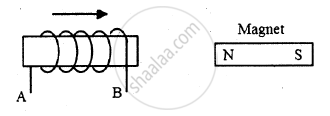
In the following diagram an arrow shows the motion of the coil towards the bar magnet.
(1) State in which direction the current flows, A to B or B to A?
(2) Name the law used to come to the conclusion.
Advertisements
Solution
(1) The direction of current in the coil is from A to B.
(2) The law used is the Lenz’s law of electromagnetic induction.
The coil is moving towards the North Pole of the magnet. Due to this, there is a change in magnetic flux in the coil. Now, the direction of induced e.m.f. (induced current) is such that it opposes this change in flux. Hence, the right end of the coil should also behave as North Pole. Hence, the current will be in the anti-clockwise direction, i.e., from A to B.
RELATED QUESTIONS
A.C generator works on the principle of ____________.
A D.C generator works on the principle of ____________.
The laws of induction were given by ______.
Fleming’s left-hand rule is also known as the dynamo rule.
Express Faraday-Lenz's law of electromagnetic induction in an equation form.
State the use of the principle of electromagnetic induction.
Explain how does the Lenz's law show the conservation of energy in the phenomenon of electromagnetic induction.
If magnetic flux is measured in weber and time in seconds, what is the unit of induced emf?
What does induction in an open circuit show about the cause of induced emf?
