Advertisements
Advertisements
प्रश्न
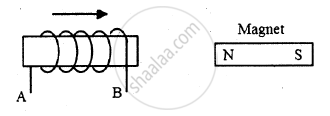
In the following diagram an arrow shows the motion of the coil towards the bar magnet.
(1) State in which direction the current flows, A to B or B to A?
(2) Name the law used to come to the conclusion.
Advertisements
उत्तर
(1) The direction of current in the coil is from A to B.
(2) The law used is the Lenz’s law of electromagnetic induction.
The coil is moving towards the North Pole of the magnet. Due to this, there is a change in magnetic flux in the coil. Now, the direction of induced e.m.f. (induced current) is such that it opposes this change in flux. Hence, the right end of the coil should also behave as North Pole. Hence, the current will be in the anti-clockwise direction, i.e., from A to B.
संबंधित प्रश्न
State Lenz’s Law.
Why does it become more difficult to move a magnet towards a coil when the number of turns in the coil has been increased?
A.C generator works on the principle of ____________.
A vertical electric field of magnitude 4.9 × 10⁵ N/C just prevents a water droplet of a mass 0.1 g from falling. The value of charge on the droplet will be: (Given g = 9.8 m/s2).
State two factors on which the magnitude of induced e.m.f. in a coil depend.
What did the experiments of Michael Faraday and Joseph Henry around 1830 demonstrate?
Under what condition is an electric current induced in a coil?
If magnetic flux is measured in weber and time in seconds, what is the unit of induced emf?
What does induction in an open circuit show about the cause of induced emf?
Why must work be done to move a magnet towards or away from a coil when an induced current flows?
